




 Get access to over 1,300 articles and reader Q&As



Several weeks ago, I wrote in ParentData about a paper arguing that phones were responsible for global test score declines. I thought the methods and conclusions in the paper were weak. In that post, I suggested we would soon learn more about the actual impacts of phone bans in schools, since they have become far more common.
It didn’t take as long as I thought — this week, a new working paper dives deep into this question with a lot of data and a solid methodology. To be honest, the conclusions of this paper are fairly underwhelming. Details below, but the top line is that these phone bans impacted phone use, but not much else.
At the same time, a second new paper provides a first look at the impacts of the social media ban for younger teens in Australia. Short answer: Few kids are adhering to it, suggesting the possible impact may be small.
In this post: details of both of these papers and a summary of where we might go next.
Impacts of phone bans in schools
There is a basic method for studying phone bans in schools, which we are likely to see a lot of in the next few years. This method uses variation in the timing of when phone bans are introduced to schools or school districts. Imagine that some schools ban phones in 2016, some in 2017, some in 2018, and so on. Researchers can see whether various student outcomes change when bans are introduced.
This method is called “staggered difference-in-difference,” although the name isn’t important. The key is the intuition: If the phone ban changes something, we should see that change when the ban is introduced, and we shouldn’t see the change in places that introduced bans later. Since this method relies on variation over time within a school or district, we worry less about differences in adopting districts than we would if we were just comparing levels.
A key element of this approach is finding good data on when schools or districts introduced bans. And this new paper does a really good job of that, using data on phone pouches. Specifically, the paper — you can read it in full here — uses data from the company Yondr, which provides phone “pouches” to schools that are used to store phones. The authors have data on the timing of pouch introduction for about 4,600 schools nationwide. These schools are not randomly selected — they tend to be lower-performing and more urban. This issue is less of a concern because the authors are using variation over time, but they also work hard to generate a more comparable comparison group.
One strength of this paper is the very large number of outcomes. They measure phone usage (using GPS phone pings), teacher satisfaction, attendance, disciplinary infractions, and test scores in both middle and high school. The table below describes the impact of the phone bans on these individual outcomes.
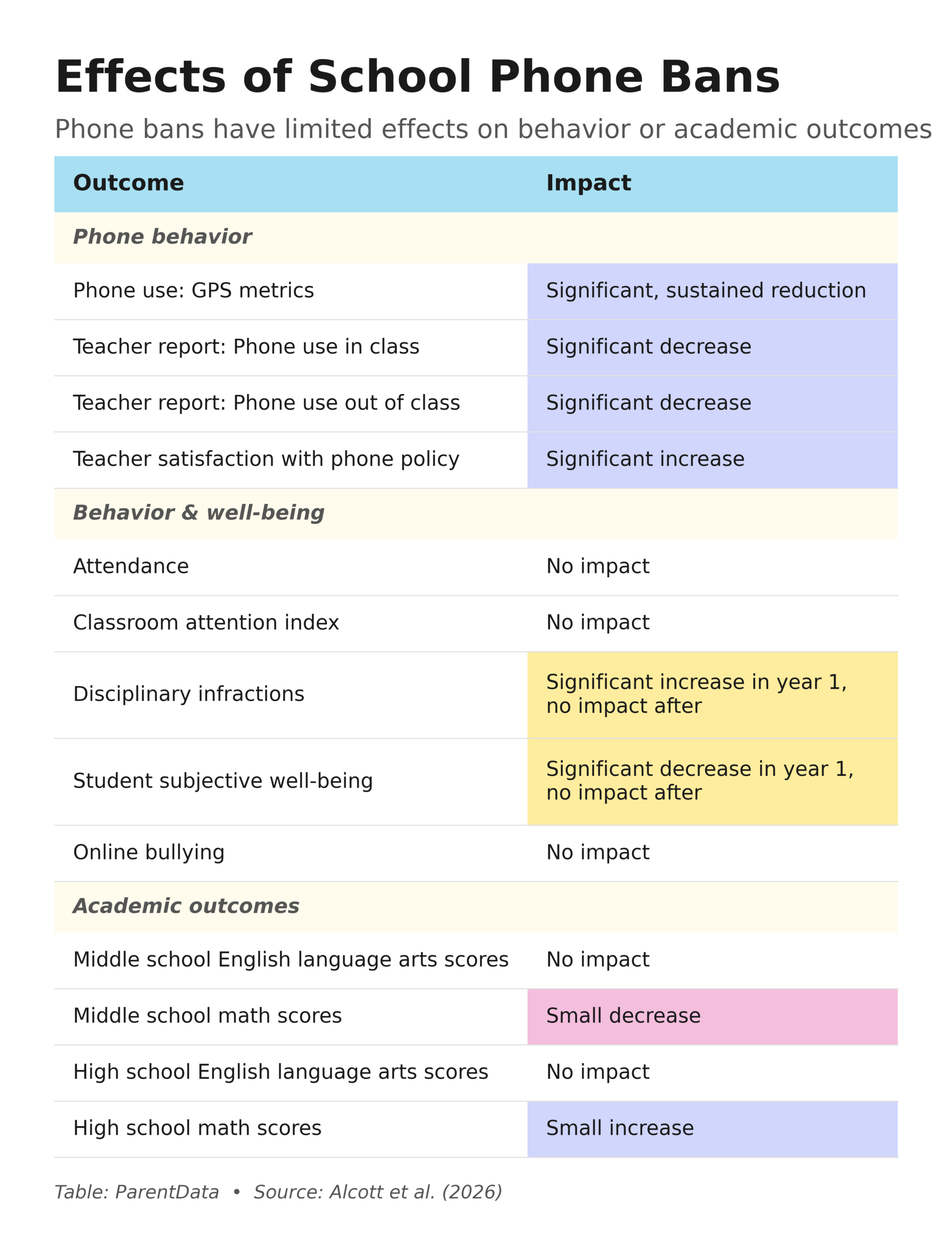
In one sense, the ban works. Teachers report satisfaction with the policy and less phone use during class and outside of class (great!). This is corroborated by the GPS data, which shows reduced phone use during the school day.
In another sense, the results are underwhelming. Disciplinary infractions go up in the first year, then return to baseline (this is consistent with the other existing paper on phone bans). Online bullying and attendance are unchanged. There is a very small positive impact on high school math scores and an even smaller negative impact on middle school math scores. Both are far smaller than most other educational interventions.
In the end, there are a couple of ways to read this paper. One is to say that phone bans can be successfully implemented, they work, and teachers are happy with them. This is a glass half full! On the other hand, to the extent that one expected large academic impacts from these bans, that isn’t showing up, at least not in this time horizon.
Australia’s social media ban, four months in
In December 2025, Australia issued a social media ban for children under 16. Kids in this age group are prohibited from using a variety of online platforms (Instagram, TikTok, Reddit, SnapChat, etc.). Enforcement is up to the platforms, which are expected to introduce various types of age verifications. There are no punishments for individual users, and there are various methods to get around this age gate.
Researchers surveyed a small sample of teenagers — about 500 — in Australia in March and April 2026, four months after the ban. Sixty-three percent of teens ages 14 and 15 (who were banned from social media) report using one of these platforms in the last week, compared to 87% among teens 16 to 18. This suggests that about 27% of kids are adhering to the ban. Not great!
When the researchers asked kids why they didn’t comply, the answers were unsurprising. They do not perceive any penalties from not complying, and the system is easy to cheat (many have never been asked to do age verification on existing accounts, and others lie). Kids expect to feel left out if they quit the platforms, and, for those who do quit, this is somewhat borne out. They are more likely to report feeling left out and bored.
Most interesting, I think, is a second survey of kids in which they were asked what share of their peers would need to comply for them to do it — what’s the tipping point? It was about 70%. At 30% compliance, Australia is not close.
Practical conclusion: As implemented, this ban is really not doing much. Enforcement on the platform side is necessary, at least to drive to a tipping point for teens.
What’s next?
For many people, these results are going to feel underwhelming. If we thought that phone bans in schools were a panacea for poor learning outcomes, this suggests they are not. We’ll learn more about that over the next few years, but I would be surprised if we found very different results.
Similarly, if you thought that the solution to kids using phones too much was to ban them, that also probably isn’t going to work as you think.
At the same time, there are still very real concerns about phones, attention, addiction, and what is the best thing for our kids. To answer that, I want to reiterate what I have said before: There is no one answer to what is right for our kids, since every kid is different. Our job with phones and our kids, like with any issue, is to set the boundaries to help them into a healthy relationship ( much more on that here).
Bans — at the school or at the country level — can be good for organizing people and giving us support, but at the end of the day, this is something we may have to lean into for ourselves. That’s frustrating! But better to know it and plan for that need than to be unprepared.
Community Guidelines



Log in