




 Get access to over 1,300 articles and reader Q&As



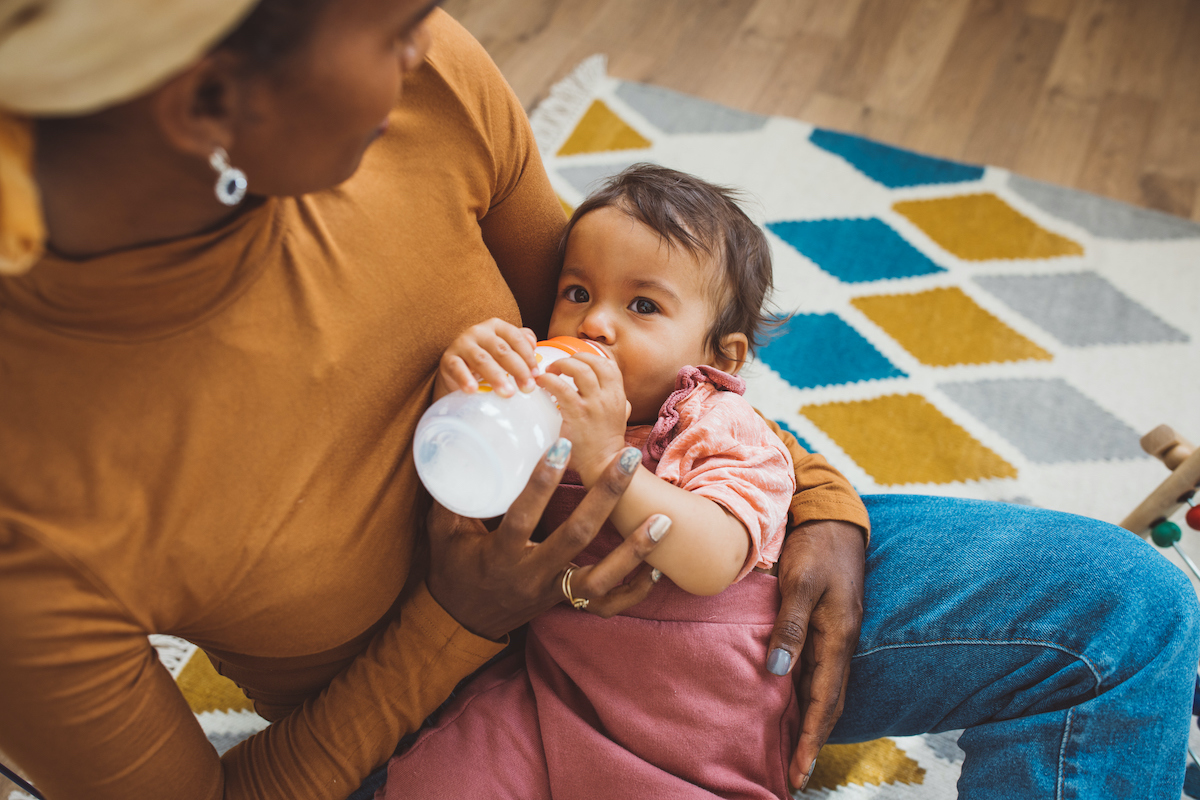
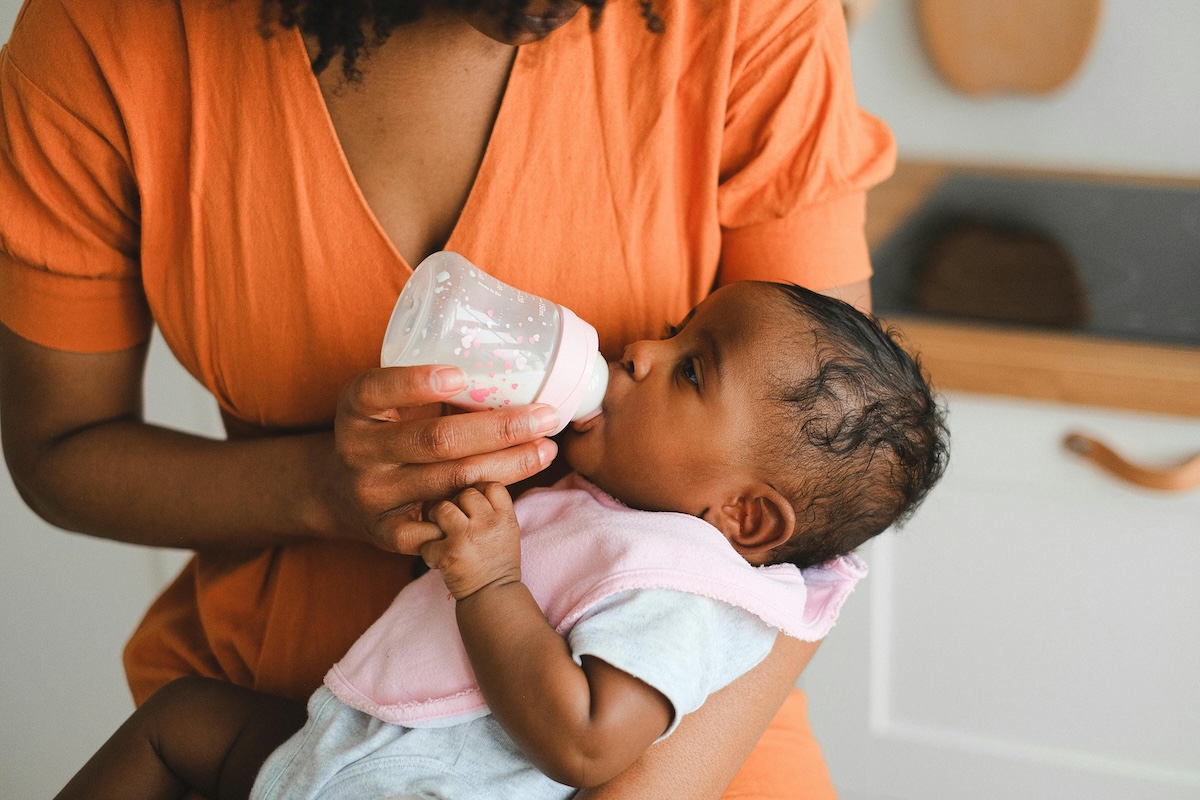
My baby almost never finishes a whole bottle of formula. When she only drinks an ounce or two, I’m left staring at the rest, wondering whether I really have to throw it away or if it’s safe to save it for later. It feels like such a waste. What’s the actual risk here?
—Watching It Go Down the Drain
Throwing away formula seems like about the last thing you want to do. It’s one thing when it’s a small amount. But when you make an eight-ounce bottle and your child only drinks an ounce, the waste is real. It’s natural to ask whether you could save the formula, even for a little while.
CDC guidelines say no. The infographic clearly indicates that any unused formula should be disposed of immediately. The main concern is related to saliva. When an infant drinks from a bottle, saliva is mixed in with the formula. This can enhance bacterial growth, and such bacteria (Cronobacter and others), consumed later, could make your child sick.
The question for the data is how significant this bacterial growth is. We can agree it is a problem in principle, but knowing how likely it is will be necessary to weigh this risk against other ones.
Several papers have tackled the issue. In the first of these, researchers had four healthy adult volunteers in their early 20s drink formula out of baby bottles. The researchers then took a sample of the formula for testing. They stored the bottles in the fridge and, three hours later, took another sample. Both samples were cultured for the presence of bacteria. They found that the infant formula bacteria resembled the bacterial makeup of saliva in both cases, and, importantly, the bacterial load wasn’t notably different after three hours in the fridge.
A second paper took this a step further, with a larger sample size. In this case, 13 young adults drank the formula, and the authors tested the samples at the start, at three hours, at 12 hours, and at 24 hours. All samples were stored at refrigerator temperatures. The researchers found that the bacterial concentrations were indistinguishable at these time frames.
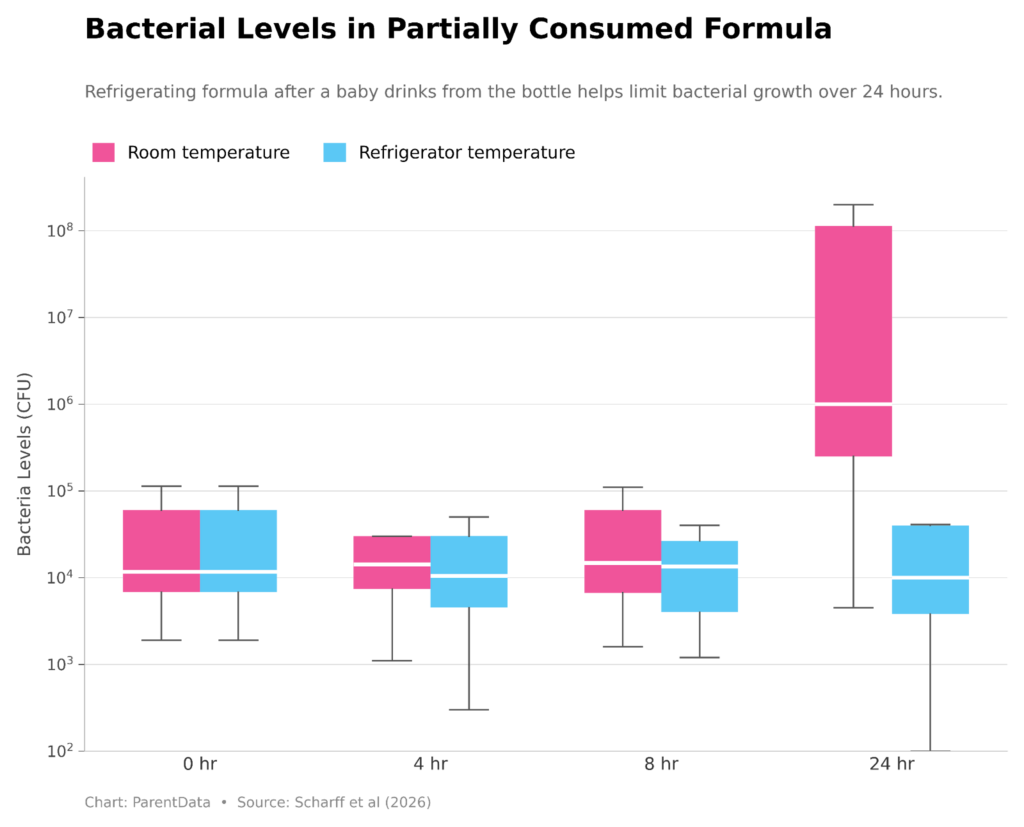
A more recent study went further still — and crucially, it used actual infants rather than adult volunteers. The researchers collected formula from 27 formula-fed babies, stored it after feeding, and measured bacterial growth at four, eight, and 24 hours at both refrigerator and room temperatures. Bacterial levels were stable through 24 hours in the fridge and through eight hours at room temperature. At 24 hours at room temperature, there was a meaningful increase in bacterial load — so that’s a reasonable outer limit if the bottle isn’t refrigerated.
The same study also looked at a question the earlier research didn’t address: How stable is prepared formula before the baby drinks from it? Formula prepared and stored in the fridge was very stable over 24 hours. Left out at room temperature, bacterial growth was also minimal on average, though there was more variation at the 24-hour mark.
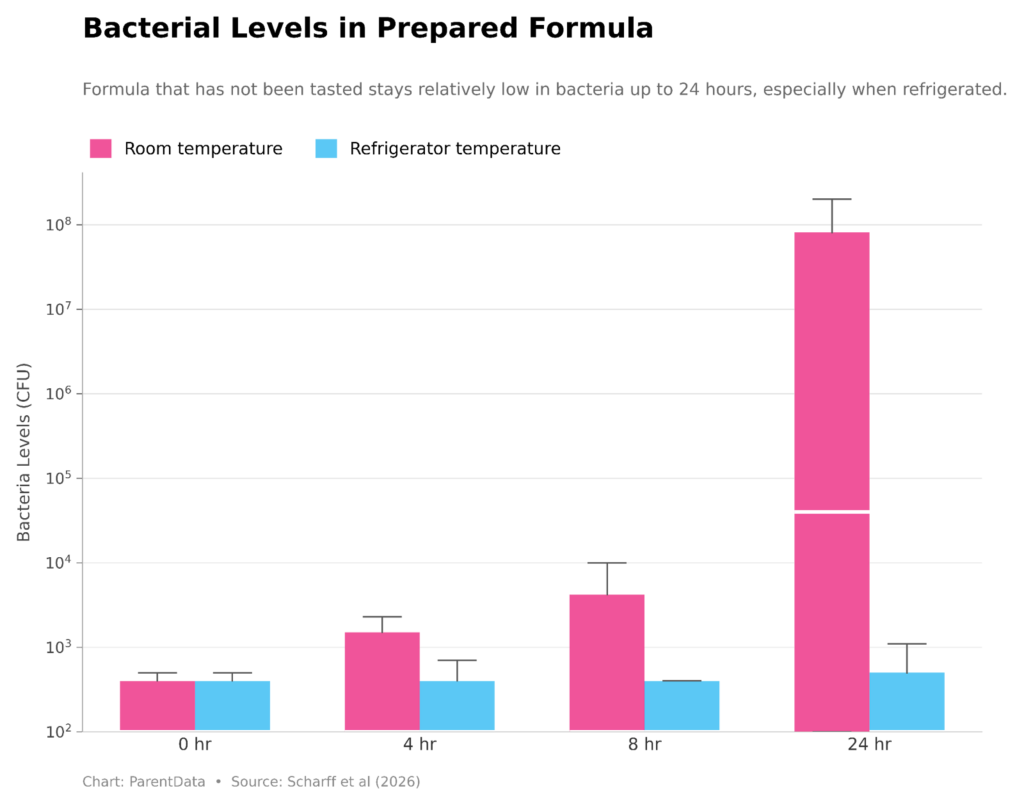
Putting these together, while it is true that the bacterial content of saliva infiltrates the formula, it does not (from these studies) look like the bacterial levels grow quickly over a period of several hours. This would suggest — as the authors of these studies do — that partially used formula could be stored in the fridge and reused for at least 8 hours and likely longer.
These papers have limitations: They have small sample sizes, and some of them don’t pull data from babies—this is a place where more data would be helpful. But this preliminary evidence does suggest that concerns about bacterial growth due to saliva may be smaller than CDC guidelines imply.
Community Guidelines




Log in
If we warm the bottle and then our baby doesn’t finish it, are we ok to put it in the refrigerator and give it to him for his next feeding, provided we don’t warm it again?
Our European formula (HiPP Dutch Combiotic) not only indicates we must discard any remaining formula after 30 minutes, but that it must always be freshly made (with boiled water that has been cooled to 40-50 C in sterilized bottles). Is it safe to assume that this research applies to even this more stringent requirement, and that we could (a) pre-make formula at least 8 hours ahead of time, and (b) use the partially-drank bottle even after 30 minutes, up to several hours, especially if refrigerated? Many thanks!
Yes — this is a very cautious guideline on both counts. And the fact that it’s a European formula probably means it’s closer to what is used in the study (which was run in Europe).
What if you don’t put it in the fridge? Our newborn is drinking very slowly. So, we make 2-3 ounces. She drinks under an ounce, we burp her and give her a break. 20 minutes later, repeat. 20 minutes later, repeat. By now, it’s around an hour and we’re not sure if we should be making another 2 ounce bottle. And sometimes she does drink the 2 ounces in about an hour so we make 3 ounces, but obviously she doesn’t drink anywhere near 2 ounces within the hour when we do that. So can we try at 1.5 hours? Or 2 hours? Or should we just toss it and start over. (The fridge doesn’t feel like an option because we’re usually holding her and sitting and then we’d need to warm it up-doesn’t seem worth it). Based on the article, we’re being a bit more lenient with the hour but I would like to know if there is a better limit to guide us.
I wonder what would happen to any residual bacteria that *did* grow while stored in the fridge when you go to re-warm that bottle before feeding again.
This is my question too. My first took cold milk no problem but little brother makes a fuss if it’s not warm.