



Does data make you panic?

- Featured
- Most/Least Popular
- Newest/Oldest
- Babies
- Medical Care
 Back to Topics

 29
29
 share
share


-
I hear you on this! I try to take solace in the things I am doing (living in a city, composting, buying used items where I can) and give myself grace on the other stuff (my toddler loves pouches, outgrows clothing in 15 mins, we use disposable diapers for baby, etc.) This season of life is hard enough, try to focus on the big picture and know that in a few years (I hope?) it will be easier to live the way you want to.
You can also start teaching your kids at an early age how important it is to care for the earth! What could be better than raising the next generation of eco warriors?
0 comments -
I feel you. On my baby shower registry I order only the most essential items and ask guest to please avoid gifting plastic. My registry contained mostly reusable diapers and wood, and cotton stuff. I asked in it for hand me downs and old baby stuff.
Now we’ve had three strollers since she was born (he’s 2). His daycare doesn’t accept reusable diapers, so we only use them when he’s home, and his toy collection has a ridiculous amount of plastic (toy cars of every size, legos, magnetic tiles, Toy Story plastic figures -3 buzz light years-)
The guilt is real, but remind yourself. This is beyond individual capacity. Our actions, unfortunately barely matter while big companies and governments do nothing to change how things are manufactured. So what you can, compost, donate toys, recicle… however, plastic and the environment is beyond any individual. Just know you are doing your part, but this is a bigger problem.1 comments-
I completely agree and had to tell myself this same thing. Huge corporations are the problem, and they’ve done a great job at making individuals feel responsible. They use green washing to make it seem like they care, and they don’t. We can only do so much, and then it’s up to policy and how much a company actually cares to follow it. No one would blame themselves. Do what you can and what is realistic, then move on. They want us to take the blame so we forget they are the problem!
0 comments
-
-
As a researcher, I will say that data is only as good as it relates to your goals in using it. Data is here for us, not the other way around. There are so, so many ways you can interpret data, so consider the source of the data and how the analysis was approached (what were *their* goals? Do they align with yours?) Data is important and so is your peace and your energy. You get to choose how those are affected by the data.
1 comments -
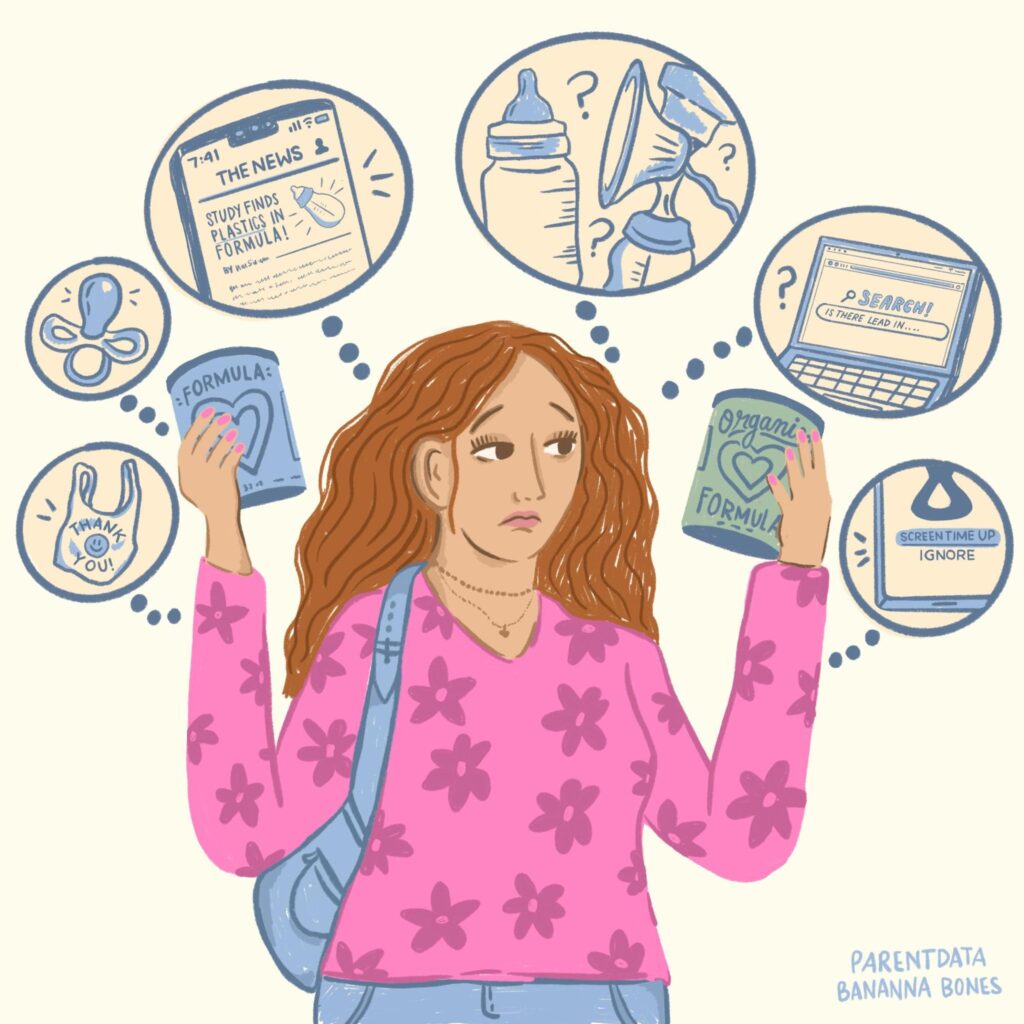
Oh man this resonated with me! Would love to see others advice because I struggle with this immensely. The amount of time I spend worrying about phthalates and microplastics and chemicals around my baby is taking years off my life. I recently deleted social media for this very reason. My feed was full of posts that made me feel bad…like I wasn’t doing enough. Sometimes a little bit of ignorance is bliss. Stress is probably worse for our lives and our babies than the thing we are stressing about.
2 comments-
Insidiously, social and other media algorithms (especially noticeable for parents) intentionally feed people content to make and keep them anxious; this is one of the emotions that increases the usage of their platforms! I noticed this the moment the algorithm learned I was expecting.
Like many others have said, this anxiety comes from a belief that we have much more control or impact, and thus responsibility, than we actually do. Looking at data as a magic bullet to parent perfectly is just one of the many ways we all try to do parenting the “right” way. It’s too much to bear. While it’s frightening to accept that our actions aren’t going to move the needle all that much or at all, or that there is literally no way to do it perfectly, it’s also pretty freeing!
0 comments
-
Man, I feel this! I take a “head in the sand” approach, for better and for worse. It lets me be a less-stressed and (for me) a better parent.
Gonna add a tangent I’m personally struggling with: an in-law has accused my partner and I of willfully damaging our kids by exposing them to Covid by sending them to daycare unmasked. Data has informed this accusation of hers. When my partner and I look at the data, we come to a very different conclusion (i.e., we are not damaging our kids). This is another fun way that data scares me. Sigh.
0 comments -
I know how you feel! As a nutricionist I have studied a lot about toxins and stuff and got really worried about all that at some point.
Now, as a mother, I try to relax about all that, otherwise I will get crazy with all of that information.
How I try to think right now:
It is impossible to protect our children from everything we wish we could, so let’s do our best and accept that we can’t be perfect.
Maybe this generation will grow more resistant to all that stuff.0 comments -
Start where you are, use what you have, and do what you can. I try to focus on what I can control – such as reducing my use of single use plastics such as disposable water bottles and k-cups. Some of the data changes (such as whether eggs are good for you or not) so I try to think about what makes sense to me and I like to generally follow the rule of everything in moderation. Good luck!
0 comments -
We mustn’t live our lives by data. That is no way to live, swinging from fear to joy with every study. Data is not “good”, it’s neutral. It sounds like you believe Science is above all else and adjust your life accordingly. Familiarize yourself with some history of science books, some articles about data replication problems, etc. and understand that “science” (not referring to the method) is fallible, corruptible, and sometimes useless. So first step is to knock science off that pedestal.
Second step is to understand that you’re not that important. Your garbage is not destroying the world. Plastic is not quietly killing your child. I don’t think you have mom guilt, you have Earth guilt. Stop and look at that child in front of you, he or she is FINE. You could have been born in any other time on earth, during a famine in Ireland, during a bombing in a war, during a Mongol invasion… no. You get to live in peace. You get to use plastic, an amazing invention that is absolutely totally useful. It’s not evil. We are so incredibly blessed to get to worry about the imperceptible killing us secretly and slowly.
If anything is bad, it’s that we throw too much stuff away. Buy secondhand plastic toys. They’re easily sanitized. I bet you’ve already bought metal straws, etc. but be aware that companies are just as eager to capitalize on your environment anxiety and push their “heirloom wooden toys” and “climate change friendly baby rompers” oh that will absolutely not be used by your grandkids, trust me.
0 comments -
This is something I constantly battle with internally. In the end, I remind myself that we can only control so much. I try to find a middle ground, control what is possible, and also use Emily’s advice to evaluate the credibility of studies as best as I can before freaking out (see her article on “Why I Look at Data Differently” – link at bottom). Plastic is everywhere. I can’t completely eliminate it from my children’s lives. But, for example, I try not to microwave or freeze food in plastic in my own house. I can’t control what happens when I eat at a restaurant or when we go to other peoples homes (cough, cough – my MIL’s house). And I also try not to think too hard about it, because it’s a never ending spiral. Data is great, it gives us clarity. Bad data isn’t great – my personal goal is to continue judging what I read, instead of taking it at face value.
0 comments -
I want to echo a few key points and state them very clearly and plainly. These three things are what I try to remember when I feel guilt or panic:
1) I will do what I can to the extent that it doesn’t impact my own mental health. My mental health will impact my children far more than the negligible impact I can have on the problem (climate change, disease risk, my children’s’ IQ, etc.) even if I do everything “right”.
2) the guilt and anxiety I feel is, in part, a result of people, corporations, governments, etc. displacing their own responsibility onto me. I don’t need to shoulder that. In this case, I feel that anger or righteous indignation is the more productive emotion. I can vote, contribute to organizations working toward my values, and teach my children to do the same.
3) work on not judging others and make lots of friends. We’re all doing our best and my best may be different from your best. When we encourage each other as often as possible, I hope we can reduce each other’s anxiety and be a stronger force for good. A bunch of autonomous, anxious, worried moms is easy to ignore, write off, and abuse. A strong, righteously angry community is a force that can make change happen.0 comments -
Preaching to the choir here, but the way I handle the anxiety is to ignore all the panic headlines and just read Emily! She usually addresses the latest in the news or you can search on the site. It have saved me so much brain space to have someone else tell me what is worth worrying about, and mostly it’s not.
0 comments -
I see a lot of content online about plastics, toxins, “clean” eating etc. The common thread with all of these seems to be trying to have a sense of control in a chaotic world. Trying to get pregnant and then having children is inherently out of control, so as parents I think the idea that we can limit “toxins” is comforting. We’ve tried to teach our kids from a very young age that plastic is forever, that manufacturing has environmental consequences, and that we can buy and have things, but should think about if they’re important to us before we do (benefits of having a mom who’s a proponent of full-cost accounting). I still cringe when I see the millions of legos in our house and occasionally let my 4 year old daughter paint her nails with regular nail polish, but we’re all just doing our best.
0 comments -
2 years, 4 months agoI continue to remind myself to “not let the perfect get in the way of the good.”
0 comments -
Wow, I could have written this exact question! (I didn’t). This is exactly how I feel sometimes when I think about exposing my daughter to plastic and my concerns about the environmental impact. I’ll write mostly about the plastic exposure part, because that causes the most panic for me personally.
This panic still shows up for me, but recently I feel like I’ve been able to reduce the panic. The main things that shifted it for me was recognizing that 1) my intention is to keep my daughter healthy and safe, and there is so much that is out of my control and 2) that I was reacting to any studies about plastic from a place of anxiety and fear, as opposed to being calm and logical about it. (actually by coming from a place of anxiety and fear, I was ignoring things that were potentially working against that intention of keeping her safe, because I would just ignore potentially useful information to keep myself comfortable).
The more I could become comfortable with the fear and anxiety, then the more freedom I felt to be able to calmly assess any new studies. Just recognizing when the fear and anxiety is present goes a long way. This makes it sound easy, and it isn’t, but it is an ongoing practice. Of course, Emily helps a lot here too, because I trust her assessment of the validity of studies, once I’m in a more calm state.
The other thing I realized, is that I was internalizing the messages that “plastic is harmful to my baby” primarily from companies that were trying to sell me a non-plastic product. Actually I went through a few phases of panicking about plastic toys and then immediately ordering a “sustainable” toy instead to ease that panic.
Send yourself so much love and compassion – it is hard to be a parent (and a human, for that matter)! Especially when there are continuous messages about all the products we “should” be buying.
0 comments -
I relate to many of the commenters here. I definitely get mom guilt and anxiety when I read new studies and data often. However, what’s really frustrating for me is that this data is out there, making many parents very worried, and yet the government seemingly does very little to protect us from corporations selling us food and self care products that are full of toxins. I understand that effects are cumulative but I see so many seemingly very healthy people experiencing devastating effects at a young age – many young couples that are going through IVF or simply cannot conceive at all, friends with daughters that are prematurely experiencing puberty, friends getting deadly colorectal or breast cancer in their 30s, the list goes on. It is terrifying as a parent of toddlers and I just wish I saw more being done by the people who are supposed to be representing and protecting us at the highest levels in our government.
0 comments -
Going to take a slightly different tone here. I suggest that when data stresses you out, consider another piece of data, like this: https://ourworldindata.org/child-mortality-in-the-past . In all times and places, until about a century ago, half of children died before puberty. Literally half. Whatever problems we have today, plastics or anything else, they are nothing compared to the unbelievable fortune of parenting in a developed nation in the 21st century. The world is awesome and it’s time to appreciate it.
1 comments -
Parenthood opens our eyes to a whole new way of seeing the world. At the same time it brings these small helpless people deep into our hearts. I remember when I realized I’d step in front of a train to protect my children. I’d do anything to save them from harm. This deep love and our new lens for seeing the world is what can causes us so much angst.
I think two things can help us navigate this time. First is to recognize that this new view of the world is important. If the only voices heard do not have this parenthood perspective then it will be harder to generate change. So where you can, vote with you pocketbook, your signature, your voice.
A statistician once told me that humans have a hard time evaluating relative risk. Driving your child to school has far, far more risk than feeding them from a plastic container. But we still get in the car with our kids every day. We mitigate the risk with a car seat and safe driving. Then we let it go and get on with our day. We can do the same with chemicals in our daily life. Learn about it. Mitigate the risks as you feel you can and then let it go.
We can none of us protect our children from all hazards in life. Step back and look at the relative risk. Mitigate and let it go. I discuss this topic further in my navigating parenthood book and a mini-book on navigating chemical toxins in family life. Looking for rational sources of information such as Emily’s Parentdata is also important.1 comments -
As a zero waste consultant and mom of a toddler, I relate so hard with this. The most valuable thing I can say here is that producers of harmful products are not held to stringent enough standards, and they revel in the social media guilt-trip that is individual consumer-centered environmentalism. It should not be our responsibility as individuals to police the production or ingredients within products that our government doesn’t even require companies to disclose are IN THE PRODUCTS. Because plenty of people here have already shared great advice on general environmental awareness, here are two things I think are proactive that I try to practice related to **microplastic exposure** as well as petroleum based ointments: 1) Accept that like all risks, our kids will be exposed to things outside our own homes and product purchases. I just try to celebrate the times that I’m able to move the needle within my own home and remember that every little bit helps. and 2) concentrate our efforts toward national, state, and local legislation/regulation about packaging, food and skin care ingredients, and playground construction (recycled tire mulch is an example of something you might wish to advocate about in your community). One agency I can recommend is the National Stewardship Action Council for a newsletter on federal level legislation that would better regulate plastics and chemicals in all kinds of products, and a lot of their peers which are usually listed in their newsletter or social media. It doesn’t feel this way, but if we all take the few minutes a month we have to sign our name to something that benefits ourselves and families, we are seeing change. It’s the guilt cycle of individual choices in the social media influencer sphere that is convincing us otherwise and distracting us from the real goal – holding entities with way more influence and capital accountable for the choices they offer us, which are extremely limited, nontransparent in their information, and based on extending profits to their shareholders – not on our preferences or our families’ health.
1 comments-
Oh! And I almost forgot about the Ecology Center of Michigan. I would be cautious about data overload, but they are an extremely dedicated team of nonprofit environmentalists doing research on different products for their environmental health implications. And they do have an advocacy component to translate their research into change.
0 comments
-
-
I’m glad (?) to see that other people are struggling with the same feelings I have. I feel a little less lonely in my feeling of “not doing it right”. The worst thing I’ve struggled with is the damn baby food pouches. We tried to get my son to use the reusable ones that we filled (which, btw, not so easy to make your own when you have two working parents regardless of what those ‘make your own baby food!’ machines say…) and he ABSOLUTELY REFUSED. We make a joke that he only likes things that cause waste. After I got shamed by the organic refill store lady for getting so many packets and went into a guilt spiral I did one thing that has helped a *tiny* bit: I bought a terracycle recycle box. They are an industrial recycling group that helps to recycle basically anything. It is EXPENSIVE so I realize it’s not an option for everyone, but if you go to the terracycle website they actually list local places where you can drop off your not-city-recyclable stuff for free. I know it’s just one more thing we’re asked to do on top of ALL the other parenting stuff, but it helps *me* to feel a little better after my son refuses to eat dinner and demands ANOTHER packet.
0 comments -
While I can’t speak to the anxiety over plastic exposure part, when it comes to usage and pollution the one thing I constantly tell myself (especially as someone who works in public policy) is that the largest polluters – petrochemical companies, manufacturing, etc – LOVE that we obsess over our individual “carbon footprint”. Shifting the responsibility from them to us as individuals allows these corporations who contribute the VAST majority of pollutants into our environment allows them to shift the blame to us. A way to combat the mom guilt over this would be to reach out to a local or state group doing environmental policy work. Find out what their top concerns are, and start emailing your local and state elected officials about structural change!
0 comments -
Yes! especially surrounding fluoride in our water and dental treatments.
https://www.ncbi.nlm.nih.gov/pmc/articles/PMC6923889/#:~:text=In%202006%2C%20the%20U.S.%20National,be%20of%20concern%20for%20neurotoxic0 comments
 RachelSF
 Vero84
 access@mattered.com
 Golden Holidays
 Emily Oster, PhD
 LjLl
LjLl
 Pterodactyl111
 A.marcon
 One Time At Band Camp
 ELD2024
 Sophie
 Leona
Leona
 DVR
DVR
 Allyson


 HJ
HJ
 User733
 lin
lin
 Kathleen@Navigating the Shock of Parenthood
 Jess Dent
 Lara
Lara
 Polythene Pam
 BRmomNB
 Kay Cad
- You must be logged in to create new topics.


