




 Get access to over 1,300 articles and reader Q&As



Here is a question I get asked constantly, in various forms: Should I have another child? Or, once that decision is tentatively made, how long should I wait? These are deeply personal questions, but I understand the impulse to look for data. If there’s a right answer buried somewhere in the research, we want to find it.
So let me do you the favor of being upfront: the data will not make this decision for you. But it can help you think more clearly, set aside some of the noise (including unsolicited opinions from everyone around you), and arrive at a decision that actually reflects what you want. Let’s walk through it.

Is there an “optimal” number of children?
Short answer: no. There is no study that tells you the right number of kids to have.
Researchers have spent plenty of time asking whether children with more or fewer siblings systematically differ in measurable ways. On one hand, firstborn children tend to receive more parental attention and, on average, do better in school. But that appears to be a birth-order effect rather than a family-size effect — it’s about being first, not about being alone. On the other hand, you’ve probably heard the stereotype that only children are somehow odd or socially stunted. The data doesn’t support that either. Studies find no strong or consistent personality differences between only children and those with siblings.
What about later in life? Some people are deeply close to their siblings and say they can’t imagine life without them. Others have toxic or painful sibling relationships. And plenty of people feel relatively neutral about their siblings. I suspect how we each experienced our own sibling relationships — or lack thereof — colors how we think about this choice for our kids. But there’s no way to predict in advance what kind of relationship your children would have.
There is also the question of resources. One version of this dilemma asks is it better to give your child a sibling or to give them more of your time, money, and energy? It’s a real and fair tension. But before you conclude that more resources equals better outcomes, it’s worth noting that the research linking specific material advantages — elaborate vacations, expensive camps — to children’s well-being and success is weak at best. What the psychology literature does consistently emphasize is stability and support at home. Those are quite different things from a trip to Hawaii, and they’re more about how you show up than about your household income.
So, no optimal number.
So how do you actually decide?
In my book The Family Firm, I lay out a framework I call the “Four Fs” for making big family decisions. It’s useful precisely for situations like this, where the evidence is genuinely limited and your preferences have to do the heavy lifting.
Frame the question. Start by being concrete about what you’re actually deciding. Are you asking should I have another child at all? or should I have another child now versus waiting? These are different questions that require different kinds of thinking. Get specific about what the alternative looks like.
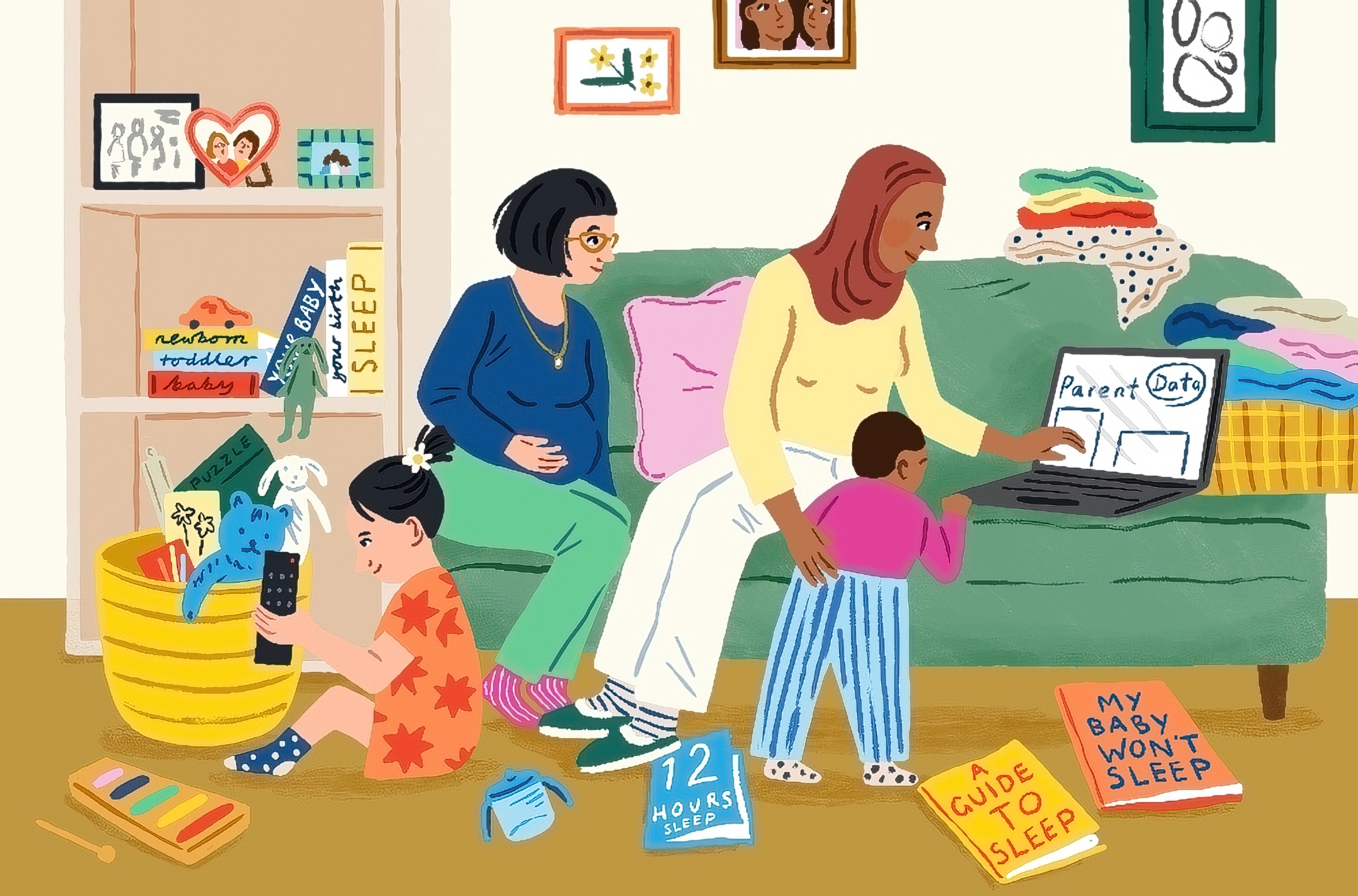
Fact-find. Put together all the relevant considerations in one place. For some decisions, this is mostly data. For this one, it’s largely about honest reflection on your own life. What would another child mean financially, in the short term and the long term? What would it mean for your daily schedule, your work, your relationship, your sense of freedom? Try to actually imagine it: if you got pregnant today, in 12 months you’d have a toddler and a newborn. What does that look like? What about in five years? Don’t just think about the abstract idea of more children — think about the concrete reality of your specific life.
Also worth examining honestly: does your family feel complete? That sense of “doneness” is hard to quantify, but it’s real data about what you want.
And one more thing worth noting: what other people think shouldn’t drive this decision. The stigma around only children, or around parents who stop at one, isn’t grounded in evidence. You can set that aside.
Final decision. This is the step people most often skip. Instead of deciding, they let things drift — going back and forth indefinitely, revisiting the question every few months as new evidence trickles in. That’s exhausting and doesn’t actually get you anywhere. Pick a date. Gather the information you need before then. Make a decision and commit to it, at least for now.
Follow up. If you decide not to have another child, schedule a time to revisit the question — maybe in a year. This isn’t the same as endlessly relitigating it. It’s a one-time check-in to make sure you still feel the same way. We’re allowed to change our minds; we just shouldn’t do it every week.
If you’ve decided to have another, how long should you wait?
This is where we have a bit more data to work with — though it comes with some important caveats.
The WHO recommends at least two years between children (roughly a 15-month minimum interpregnancy interval, meaning the time between birth and the next conception). This guidance is based on studies, including a large JAMA meta-analysis, which found elevated risks of preterm birth, low birth weight, and small size for gestational age when pregnancies are spaced less than 18 months apart. The effects were most pronounced for intervals under six months.
Here’s the catch: a substantial portion of the research underlying those recommendations comes from lower-resource settings, where the physical toll of pregnancy is harder to recover from due to factors like food insecurity and limited access to prenatal care. Short interpregnancy intervals increase risks of anemia and nutritional depletion that, in those contexts, make subsequent pregnancies genuinely riskier.
When the analysis is limited to higher-resource settings, the picture changes. The negative effects for intervals longer than six months become much more tenuous. Even the effects for short intervals may partly reflect differences between women rather than the intervals themselves. One particularly well-designed study using birth registry data — which allowed comparisons within the same mother across pregnancies — found that very short intervals (under six months) were associated with increased preterm birth risk when comparing across women, but not when comparing within women. That’s a meaningful distinction.
What about very long gaps? Some research suggests that intervals of more than 60 months carry their own elevated risks, though this may reflect other underlying differences between women who have very long gaps rather than the spacing itself.
There’s also the question of C-section recovery. Data indicates that the risk of complications in attempting a vaginal birth after cesarean is higher for pregnancies conceived within six months of a C-section. Again, the concern is most acute for very short intervals. In high-resource settings, the evidence for risks from pregnancy intervals of 12 or 15 months is much weaker than the standard “18-month rule” implies.
Putting this all together: in a high-resource setting like the U.S., the evidence for meaningful risk at 12 or 15 months is much weaker than the standard “18-month rule” implies. The data consistently flags very short intervals — under six months — as worth avoiding. Beyond that, the risks become smaller and less certain.
The timing trade-off: spacing vs. age
One thing I think deserves more attention in these conversations is that for many people, the choice isn’t just “wait versus don’t wait” — it’s “wait and be older versus don’t wait and have a shorter spacing.” And those risks don’t pull in the same direction.
If you’re in your mid-to-late 30s, waiting an extra year or two to meet a spacing recommendation means a pregnancy at an older age, with the associated increases in risk for chromosomal differences, fertility challenges, and other outcomes. There is no obvious “safe” default. Sometimes what looks like a conservative recommendation is actually just trading one kind of risk for another.
This is your call to make, in conversation with your own doctor and your own circumstances. What I’d resist is the idea that there’s a universally right answer buried in the guidelines. The guidelines were built on studies that may not apply to your situation, and your situation — your age, your health, your recovery from the previous pregnancy, your family’s finances, your mental bandwidth — matters enormously.
The bottom line
- The data doesn’t provide much guidance about the ideal number of children or birth interval between them.
- Only children are not worse off, and more siblings don’t mean better outcomes.
- The 18-month rule for birth spacing is mostly based on research from lower-resource settings. In the U.S., the real concern is intervals under six months — beyond that, risks are small and uncertain.
- If you’re older, waiting longer to hit a spacing target means getting pregnant at an older age, which has its own risks. There’s no universally safe choice, just tradeoffs specific to your situation.








Log in