




 Get access to over 1,300 articles and reader Q&As



All animals sleep or have a sleep-like resting state. This includes those who live in the ocean — dolphins sleep half their brain at a time. This fact suggests that sleep must be extremely important, since it seems otherwise very maladapted. No time are we more vulnerable than when we are sleeping (it’s a perfect time to be eaten by a sabertooth tiger!), so we must be getting something out of it.
Interestingly, researchers don’t know why, exactly, sleep is so important. There is some really cool recent evidence from mice suggesting that changes in brain wave patterns during sleep may be important for clearing metabolic waste out of the brain. But we clearly need to study this more.
It is easier to study the impact of sleep on our ability to function. I’ll get into this first below and ask how much we know about the impact of sleep on health and cognition. Then the second part of this article talks about what to do if you aren’t sleeping enough.
Note: I’ve written about kids and sleep before, but this is largely about sleep for adults.

How important is sleep for overall health?
There is a huge body of evidence on the value of sleep. One place where sleep clearly matters is for cognition. In general, sleep deprivation reduces working memory and overall cognitive functioning. It contributes to traffic accidents, inability to focus, and mental health impacts. There is extensive data on the impact of total sleep deprivation (not sleeping at all for a night or two) based on laboratory data.
Negative effects can be seen even without missing entire nights of sleep. Consistently getting too little sleep may be equivalent to missing one to three nights entirely.
Sleep deprivation is also thought to impact health beyond the brain, although the evidence is less direct, in part due to it being harder to measure. It is easy to see brain impacts because they happen immediately. Looking for effects on heart disease (for example) requires looking over a longer period. However, we do see that experimental sleep restriction impairs insulin resistance, which can contribute to Type 2 diabetes and other metabolic diseases.
How much sleep do we actually need?
Generally, it’s thought that adults need at least seven hours of sleep a night. Of course, there will be some variation. On a practical level, the first question you might ask is how you know whether you are getting enough sleep. The answer is going to be largely the same as when we discuss it with kids. If you are well-rested, you should wake up at about the same time every day. In particular, if you normally wake up with your alarm at 6 a.m. but without an alarm, you’d easily sleep until 10 a.m., you are not well-rested. The second question is whether you’re tired during the day. If you find yourself yawning or falling asleep in meetings, this is a good clue that you are not getting enough sleep.
To the extent that there are average differences across sexes, they are not likely to be large, but there is evidence that women are more likely to be sleep-deprived. This article does a nice job of discussing the situation: women face more hormone-related disruptions, more life-cycle-related disruptions (such as children), and so on.
Perimenopause and menopause transitions mess with sleep. Pregnancy messes with sleep. Postpartum hormones mess with sleep. Puberty! I’m holding out hope that when I’m old, I will sleep amazingly, but I think old age also messes with your sleep.
We should be realistic about sleep goals: most parents are at least somewhat sleep deprived. I’m not telling you anything you do not know, nor am I trying to make you feel worse about it — but knowing this should at least tell us why thinking about supporting sleep is important. When I talk to people about this, though, they tend to have two issues. First, they feel as though there is no time to sleep. Second, they have insomnia.
Do you feel like you don’t have enough time to sleep?
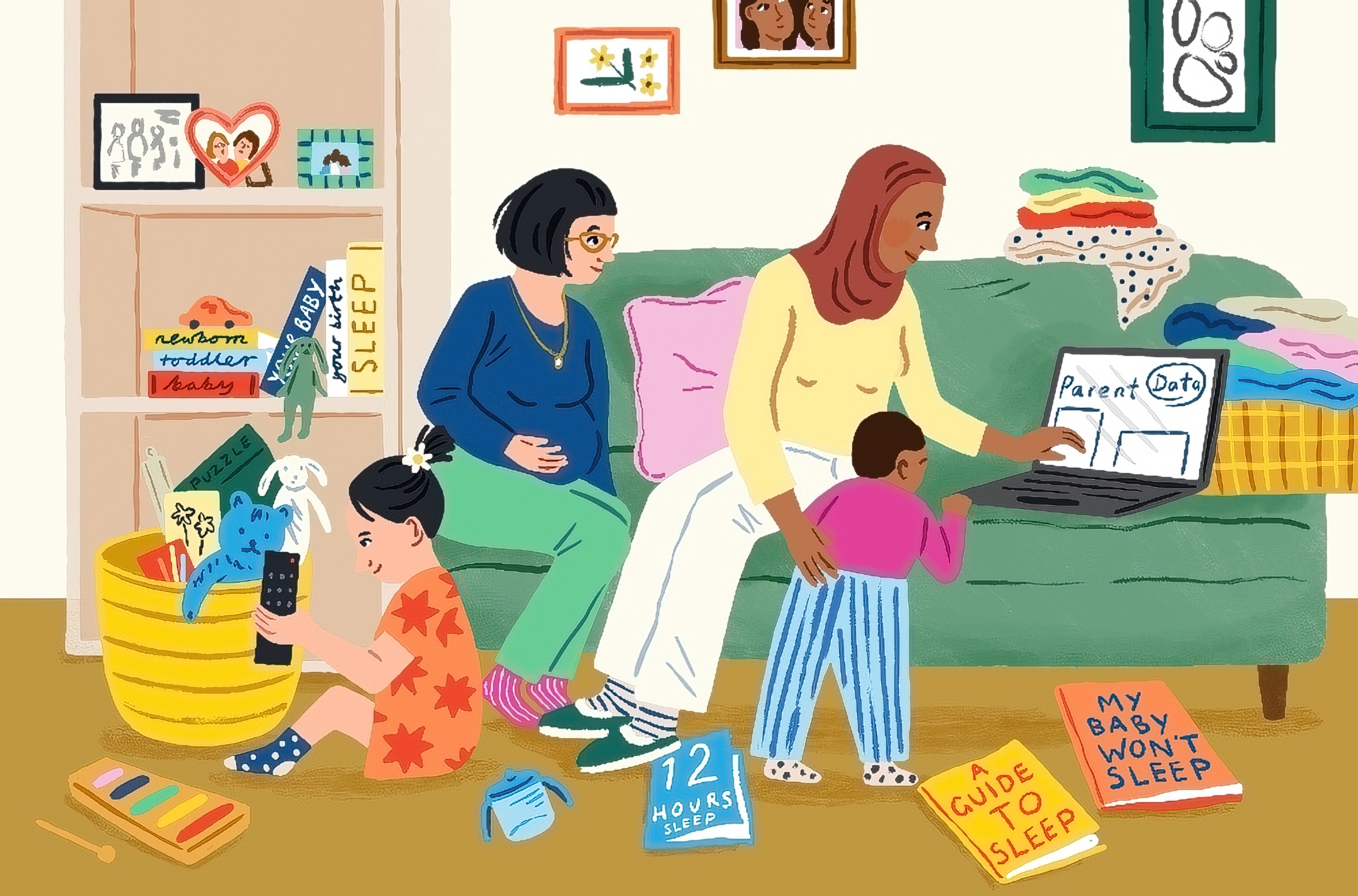
When I talk to parents about sleep, the number one thing I hear is that there is no time. Most parents say they’d love to sleep more, but it is just impossible to do that.
I would like to gently push back here and suggest that, at least, you carefully consider whether there is anything you can do. In doing that, I would encourage you to keep the following two things in mind.
First, sleep is not optional. Too often, people think of sleep as a luxury — like a pedicure, perhaps. Something that would be a nice-to-have, but not a necessity. This is not true, and I hope the data above is at least somewhat convincing on that point. Adequate sleep is a biological need — it’s more like pooping than like a pedicure. And like pooping, if you don’t make time for it, accidents can happen.
Second, getting more sleep will involve doing less of something else. Time is finite; there are only 24 hours in a day, and there will be tradeoffs. You should evaluate those tradeoffs with an eye to the importance of sleep. It is possible, even likely, that there are things worth giving up to sleep more.
To be slightly more practical, a few things to consider …
If your baby is very small: With most newborns, there is no avoiding the need for many nighttime wake-ups. Practical possibilities here include splitting the night with a partner, getting outside help for the occasional night (a grandparent or friend, even, just to get a break). But the reality is, you are most likely going to be tired, you probably aren’t getting enough sleep, and this stage will not last forever, even if it feels that way.
If your baby is over 4 or 5 months: Sleep training isn’t going to be for everyone, but the data is reassuring that it doesn’t cause damage to children, and it will be in many parents’ toolboxes. The data also shows that sleep training improves adult sleep (because it improves baby sleep). This is a solution worth considering.
If your problem isn’t your kids: As kids get bigger, it’s more likely they are sleeping, and you are not. Sometimes, this is bedtime procrastination — it feels like the one moment to ourselves. Sometimes, it’s work or household activities or something else. What I would suggest is that you simply ask, if it were absolutely crucial, where could I find another hour of sleep? It may be that there is simply nothing you can do to sleep more — but, again, if you frame this as a true priority, you may be more likely to find the time.
I know — trust me, I really do — that being told “just sleep more” is frustrating when it feels impossible. All I am suggesting is that before you decide it’s impossible, take a few minutes to ask what is possible if you decided it was a top priority.
Do you have insomnia?
Approximately 10% of the population suffers from chronic insomnia ( defined as a consistent inability to get quality sleep over a period of at least three months, for at least three nights a week). We all have nights where we do not sleep well; chronic insomnia is when this happens over a long period. Sometimes this means the inability to fall asleep at the start of the night; other times it means long periods of awake time during the night. Given how important sleep is, chronic insomnia can be incredibly disruptive to people’s lives, and people may suffer for years.
For many people, chronic insomnia can be treated with cognitive behavioral therapy for insomnia, or CBT-I. This treatment, usually facilitated by a therapist, focuses on direct behavior modifications to decrease insomnia and improve sleep consistency.
CBT-I programs are well studied in randomized trials. A 2024 meta-analysis covered 241 trials with over 30,000 participants. They found the most effective programs included several key components.
First, cognitive restructuring, which involves reframing catastrophic thoughts (“If I don’t sleep tonight, tomorrow is ruined”), and other thought-based changes. Second, third-wave components, like mindfulness and meditation. Third, sleep restriction — here, people are encouraged to initially limit their planned sleep time to the amount that they are typically sleeping. So rather than going to bed at 9 p.m. and lying awake until midnight, you go to bed at midnight, with the goal of retraining yourself to fall asleep quickly. Finally, stimulus control — limiting the bed to a place for sleep and sex (no TV, no scrolling) and leaving the bed if you cannot fall asleep.
I don’t want to oversimplify these approaches — each of them is much more complex than a single sentence. And these approaches were most effective when delivered in-person. The overall difference relative to the placebo group was large — treated individuals were three times as likely to recover.
Despite this efficacy, many people with chronic insomnia do not get this treatment. But they should! If you’re struggling with sleep, I hope you will consider this option.
The upshot: sleep is important, and should be treated as such. It’s worth prioritizing, and if you can’t sleep, there are ways to fix that.
The bottom line
- There is a huge body of evidence on the value of sleep, showing that even mild deprivation impairs cognition. It is a biological necessity, not a luxury.
- Most adults need at least seven hours of sleep, and simple signs like sleeping in when you don’t set an alarm or feeling drowsy during the day can reveal whether you’re getting enough.
- While many parents feel there’s simply no time to sleep, it’s worth honestly asking what tradeoffs you could make to prioritize it, whether that’s splitting nighttime duties with a partner, sleep training, or cutting back on your own late-night screen time.
- For some, there are more significant roadblocks to getting more sleep — chronic insomnia affects about 10% of people, but it can be effectively treated with CBT-I, a therapy combining techniques like thought reframing, mindfulness, sleep restriction, and stimulus control.








Log in