




 Get access to over 1,300 articles and reader Q&As



In October 2025, a new paper was released in the Journal of Adolescence arguing that increases in smartphone usage globally may contribute not only to mental health issues in teens, but also to global declines in test scores in math, reading, and science.
The paper has gotten a reasonable amount of attention online in the last few weeks. Jon Haidt’s Instagram post of the key graph has 13,000 likes and almost 10,000 shares.
On a careful review, however, I do not think the results in this paper stand up to scrutiny. I want to talk about that today, in some detail, for two reasons. First, I suspect this audience will hear about these findings in various ways, and I want you to have context. But second, perhaps more importantly, this is representative of an issue I increasingly see in discussions of screens, phones, and social media: an overstatement of results.
As I’ll talk about at the end here, I do think we need to think carefully about the impact of phones and screens on learning (and I’m a huge fan of phone bans in school). We do not, however, do that work any favors by overstating what we know and amplifying results that are not compelling.
So, what are the issues with this paper specifically that are representative of a bigger problem? And what do we know about these issues (with better data)?
Smartphones and global test scores
The analysis in the Journal of Adolescence paper is fairly straightforward. The authors use data from the PISA (Programme for International Student Assessment) test — a global exam administered every three years by the The Organisation for Economic Co-operation and Development (OECD) to evaluate the academic performance of 15-year-old students across participating countries. The PISA measures skills in reading, mathematics, and science.
The paper has several analyses, including one on loneliness, but I’m going to focus on their test score data (for simplicity, I’ll focus on their math test scores, where their result is the strongest). The core finding in the paper is that between 2012 and 2022, test scores on the PISA declined, and the decline was greater in countries with higher smartphone adoption (Mexico, Germany, Portugal, Czech Republic, Greece, Chile) than in those with lower smartphone adoption (Sweden, Denmark, Norway, Japan, South Korea, Ireland).
The authors use 2012 as the starting point for their analysis because that was the real beginning of Instagram. They use 2022 because it is the most recent year of the data. However, there is a core issue with this latter data point — the COVID-19 pandemic. We know COVID impacted test scores, through school closures among other things, so it is reasonable to wonder how much of the results is driven by this latter period.
It turns out, all of it. The graph below shows the change in these countries between 2012 and 2018 and then between 2012 and 2022. Between 2012 and 2018 — a period in which smartphone adoption was also increasing — the two groups of countries look very similar. If anything, test scores decline more in the low-adoption countries. When we push out to 2022, this is when the high-adoption countries fall way off.
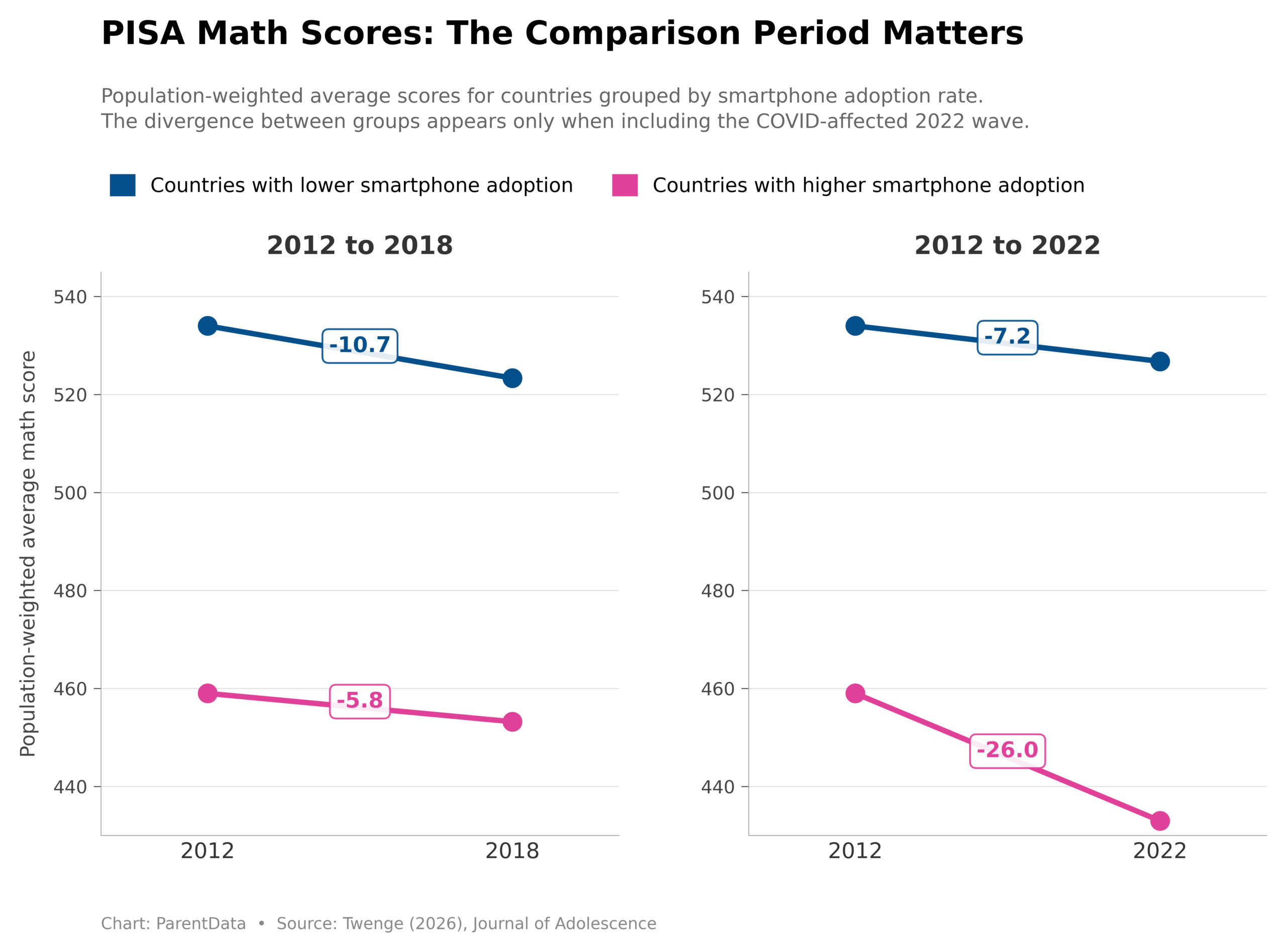
Of course, one interpretation of this is that the rates of decline in test scores are solely due to smartphone adoption during this period, not the pandemic. However, these countries also differed dramatically in their school closure pattern, as can be seen in the second graph. The countries that had more smartphone adoption also had dramatically longer school closure periods during the pandemic. We know that school closures impacted test scores, so this gives us an obvious alternative explanation.
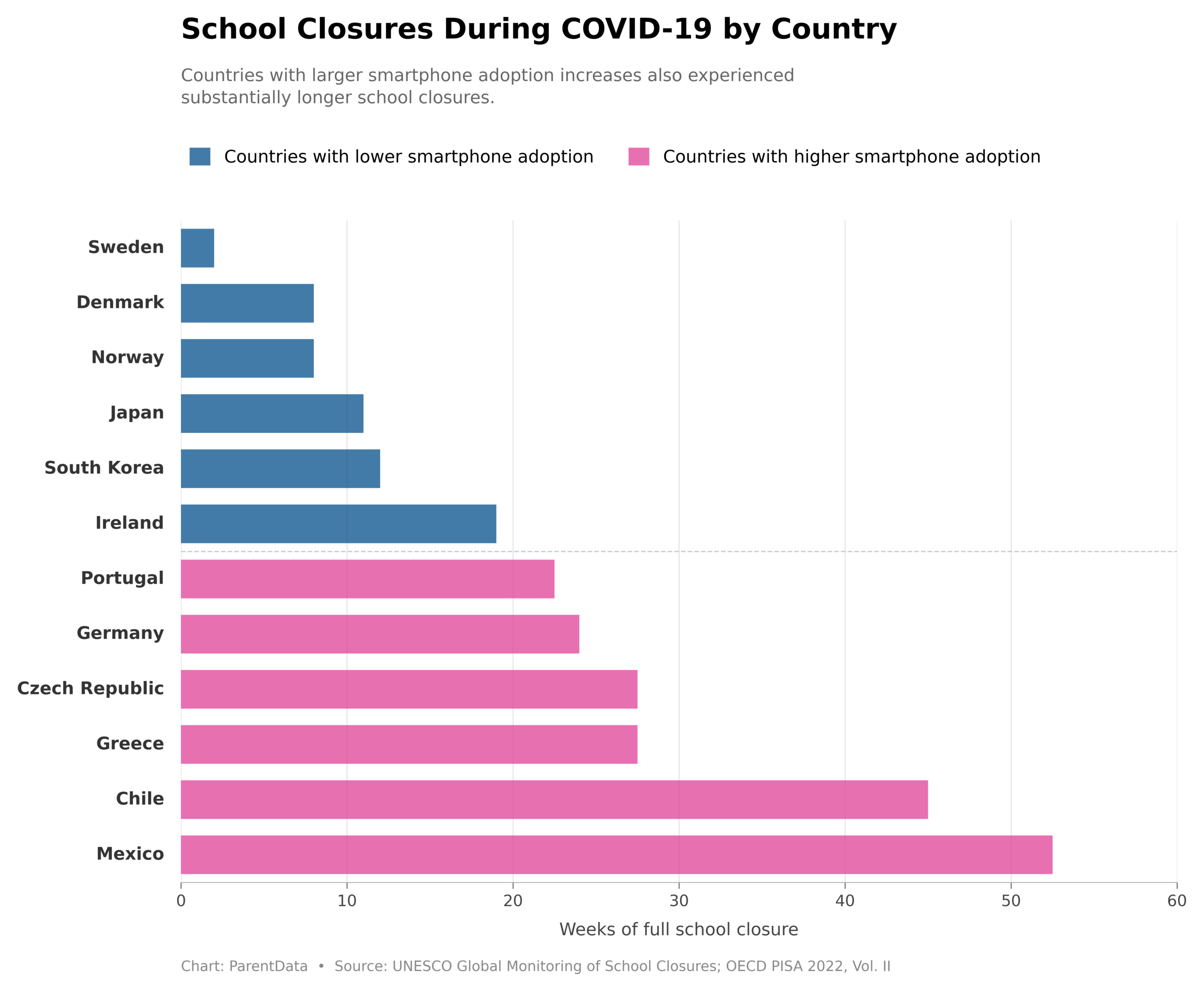
I want to be clear: these graphs do not rule out a connection with smartphones. It could be that the pandemic school closures drove smartphone increases, and then the smartphone increases drove declines in test scores. However, this explanation feels less plausible to me than the view that school closures drove both declines in test scores and perhaps an increase in smartphone use. Or, simply, that school closures drove test score declines, and it happens they were correlated with smartphones.
The bottom line is that, given the issue with COVID-19, this paper really cannot say anything definitive, or even very suggestive, about smartphones and test scores. It doesn’t necessarily rule out a story; it just tells us, more or less, nothing about this question.
What do we know about phones, screens, and learning?
The first thing to say is that we are probably never going to have an answer to the biggest question in this space — the question of whether phones and screens broadly lower test scores. We see trends in global test scores over time — like these PISA scores. Are these trends due to changes in screen exposure? We do not know, and it is difficult to imagine how we’d get data to say anything compelling here.
What we can hope to get answers to are more narrow questions, like whether phone bans in school work or whether computers in the classroom are beneficial or harmful. And while these questions are less sexy, they’re also more practical. A policy of get rid of smart phones is very unlikely to be practical; a policy of bell-to-bell phone bans in school has proved to be quite feasible.
We have a bit of data on this already. One early paper on phone bans shows some small increases in test scores two years in. I suspect that within the next two to three years, we will have many, many more results on these changes since many school districts and states adopted phone bans this academic year. We have more data on broader educational technology use, which is somewhat mixed. Used thoughtfully, screens seem like they can be helpful for learning. But it’s clear they can also be distracting and overused.
Experimentation in college classrooms shows students learn slightly less when they are allowed to have laptops in class than when they are not. As a college professor, I will say I believe this, but I think the mechanism is limiting distractions rather than something about kids learning better by writing things down. I do not let my students use laptops in class because I think it stifles discussion, and I worry that even students who want to focus will be distracted if the person in front of them is playing Roblox or texting their friends.
All of these impacts — school phone bans, college laptop bans — are fairly small. That is likely what we should expect going forward. It’s not that these things do not matter, but there are a lot of inputs to academic performance.
Why messaging matters
I am very sympathetic to the concerns raised about social media, phones, screens, and kids. I’m not only steeped in this academic literature, I am also a parent of a teenager. I think a lot about how we can help our kids create boundaries, about the feasibility and practicality of legislative solutions, and about how we can get better and more informative research on these questions. I’m a huge fan of phone bans in school — no one needs 14 push notifications from ESPN during third-period math — and I believe we should be encouraging kids to do more in the physical world and less in the digital one.
Having said this, I believe there is a real need, like in virtually all public health messaging, to be careful that the statements we make are backed by good evidence. When we overstate the case — whether that’s the case against phones, the case for breastfeeding, the case against raw milk, the case for masking during COVID — trust is lost, and extreme positions can also cause people to throw up their hands.
I’m increasingly seeing rhetoric around screens at school that sounds like “Let’s not have computers at all before high school.” This is ridiculous, it’s not supported by data, and it’s totally impractical for the modern world. This kind of extreme messaging is also very frustrating and useless for parents. Parents need help navigating these issues in a realistic way, not to be told their children are screwed unless they move to the forest.
The upshot: smartphones are probably not the reason that PISA scores declined from 2012 to 2022 — that was almost certainly school closures. But please do stay tuned over the next few years, as we will learn much more about the impacts of the practical changes being made to screen usage at school.
The bottom line
- There is little compelling evidence that smartphone usage has driven global test score declines.
- Early data on phone bans suggests small effects — more to come on this in the next few years.
- Realistic messaging on smartphone usage should recognize the need for change without overstating the data.









Log in