




 Get access to over 1,300 articles and reader Q&As



Deciding about child care is one of those parenting choices that feels uniquely stressful because you are being asked to decide something important before you have any relevant experience. If you’ve never had a baby before, you have likely never thought about child care before, and yet you are supposed to make this decision that feels really big. On top of that, it’s both expensive and hard to find, so you’re dealing with logistics on top of trying to think about what is best for your baby.
There are many options. The most common child care solutions are either day care (in-home or center-based) or a nanny. But some people have family help (grandparents, for example), or you may use a combination of all of these. Starting with such a huge range of choices can be paralyzing.
This is made more stressful by the timing. Especially if you are considering out-of-home child care, you need to be on a wait list well before your child is born. The decision feels urgent, and it’s one you need to make before you really have all the information (notably, before you have even met your baby).
Take a deep breath! This decision is manageable, I promise.
The first thing to know: there are many good options here. Despite what you may hear online, day care isn’t bad for children. The evidence points to very similar outcomes for children who attend high-quality day care and those who are home with a caregiver or parent. Often, this decision takes on added stress for parents because they feel like one option could be a terrible disaster. It’s not!
Once we take that off the table, we can come to this in a more neutral way and really focus on what works best for our families.

Ask first: what is feasible?
The first step in this decision should be simply outlining the options that are logistically feasible. Some considerations:
- What is affordable? Given the prices in your area for various kinds of child care, what are the realistic options?
- What resources are available? Are there grandparents who would like to be involved in child care, and in what way?
- What will you need to make child care work with your job? Depending on the timing of commutes and work, some options may just not be possible.
- Is there a world in which one parent chooses to stay home? Is that an option to consider, whether short or long-term?
I would urge you to make this feasibility discussion very broad; really use it as an opportunity to talk about what your family wants, and what you think is possible. This is also a time to think about what you feel comfortable with. Some people are very uncomfortable with the idea of a single caregiver; others find this more reassuring. There is no single answer here, but being honest with yourself (and your partner if you have one) about what you want is key to being happy with where you end up.
Let’s assume you come out of this with a plan for either out-of-home day care, a nanny, or maybe still torn between the two. This means you’ll either be visiting day care options or interviewing nannies. How do you find the best one?
Evaluating day care options
In the literature on child care and child outcomes, the data show that day care “quality” does matter for how kids do later in school and on behavioral dimensions. This leads to the question: how is quality measured, and how can you evaluate it?
Data to help with this comes from studies like the one done by the National Institute of Child Health and Human Development (NICHD).
The NICHD is a longitudinal study (meaning it follows kids over time) of more than 1,000 children, designed to evaluate the impacts of various types of child care (day care, nanny, family member) on child development. NICHD researchers were interested in outcomes like language development and behavior problems.
In the study, researchers actually went into the day care centers where the study children were enrolled and evaluated them. They sat in the classroom and observed the teachers and recorded other facts about the day care, and then they ranked them, determining which day cares were higher “quality” than others. Their measure of quality strongly correlated with both later cognitive ability and behavioral issues.
The quality measures they were looking for may not be the ones that come to mind. They weren’t looking for all wooden toys or organic snacks. They didn’t evaluate the curriculum to see if it had enough focus on, say, penguins or dinosaurs. Overwhelmingly, the evaluation of day care quality focused on basic safety and on the interactions between the providers and the children.
Here’s a sample version of their checklist that you can use.
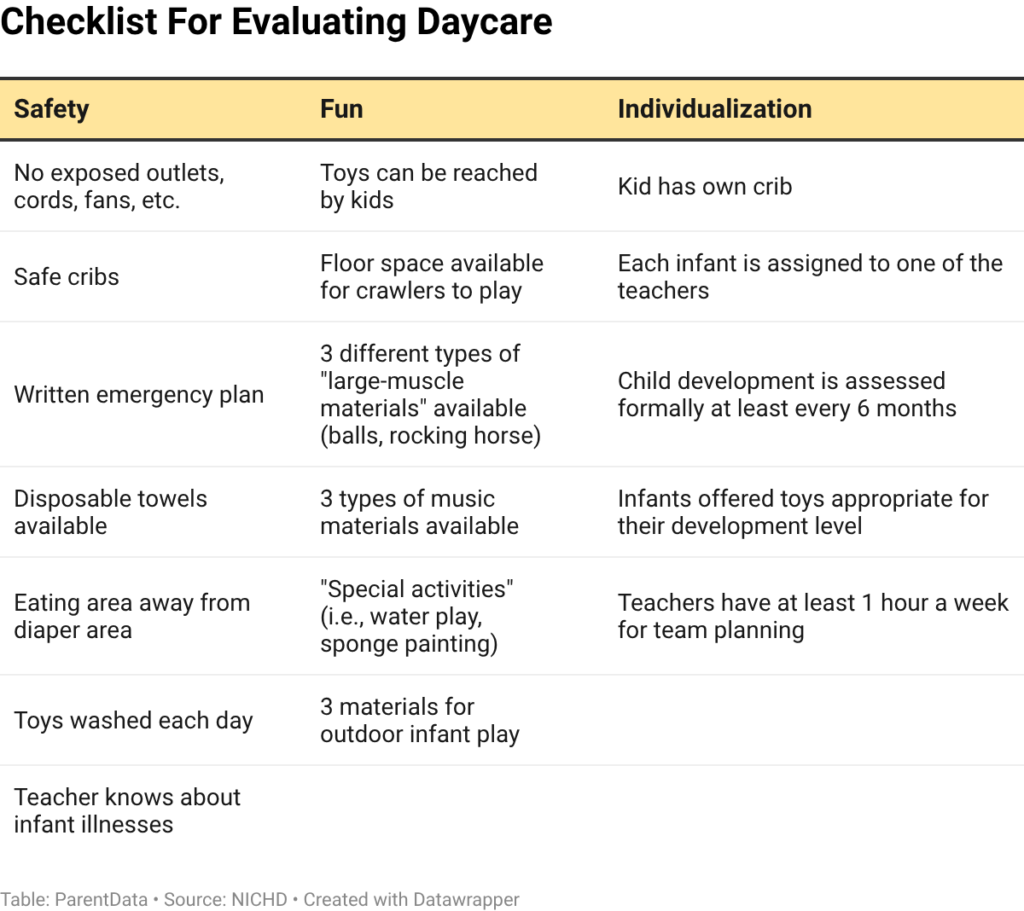
Most of these things can be easily observed and recorded on a day care tour.
The researchers also assessed quality by watching children at the day care for several ten-minute periods. They were looking for a few things:
- Are the adults interacting with the children?
- Do they hug and hold the children in positive ways?
- Are the adults talking to the children and reacting to them?
- How are adults responding to behavioral issues? The researchers were looking for consistent boundaries and a lack of physical punishment.
- Do the children seem physically well, and are they getting a chance to play?
You are not a trained day care observer, but if you are given a chance to observe the classroom, you can likely get a strong sense of many of these things. It is very unlikely a caregiver would hit a child in front of you, but negative affect and a lack of warmth aren’t actually very hard to pick up on. And it’s hard to fake the opposite.
A reasonable question to ask is whether this is all just a way to say you should pick the most expensive day care you can afford. It is true that quality and price are correlated: more expensive day cares are going to be, on average, higher quality. But the main component of quality—how the care providers interact with the children—is not about price.
Hiring a nanny
The NICHD study also evaluates the quality of at-home child care, with the same results: higher-quality child care, as determined by the metrics they can measure, is better. However, quality in this case is even harder to evaluate than for day care.
The study uses a similar evaluation period and checklist to see if the caregiver is responsive to the child, if there are toys and books around, and if there is yelling or hitting (both bad).
Unfortunately, it is likely to be much harder to do a reliable evaluation of a single adult–child interaction, where it will be obvious the researcher is there, watching the caregiver, than at a day care, where you can more easily fade into the background.
There is simply very little concrete guidance about how to find and evaluate a nanny. Perhaps the most useful piece of advice I got in doing this was to talk to references (of course) and try to evaluate not only whether they liked the person but also whether the person doing the referring seemed like me. Were we people with similar needs?
It can also be useful to have candidates answer some basic questions in writing. When you’re interviewing someone, it can be hard to remember everything you wanted to ask. If you use an agency, they’ll often provide a suggested questionnaire. If not, you can find some online.
Hiring a nanny is a bit of a leap of faith, and you may have to trust your gut.
Making the final decision
Decision-making is hard. Once you’ve thought about what is feasible and done your research, interviews, or visits, you’ll have to pull the trigger on one of these options. That can feel daunting because commitment is hard. It will be useful to remember two things.
First, although this decision does matter, and you want to make it thoughtfully, this isn’t a decision that will make or break your child, and what you do as a parent when you’re with your kid matters a lot more. So, absolutely do think about this, but do not give it more attention than it needs.
Second, no decision is forever. When you choose an option, you are choosing a starting point, but not an ending point. It is okay to decide later that something else will work better. In fact, I’d urge you to plan for that possibility; put a time on the calendar to revisit this decision when your child is, say, 6 months or a year old. Doing this will both ensure that we do it and give us confidence to pull the trigger, knowing that we’ll get another shot if it does not work out.
The bottom line
- When deciding on a child care arrangement, start by asking what’s actually feasible for your family (financially, logistically) so you can narrow the field to realistic options.
- What matters most in day care quality isn’t fancy materials or price, but basic safety and warm and responsive interactions between caregivers and children.
- When considering nannies, it’s harder to observe interactions. You can rely on references and an interview, but it’s a bit of a leap of faith, and you may have to just trust your gut.
- Choosing child care can feel overwhelming, but whatever you choose is a starting point, not a permanent decision, and can always be revisited later.








Log in
One option that isn’t listed (but may fall under the nanny category) is an au pair. It’s cheaper/ about the same as 2 kids in daycare and offers a lot more flexibility. It’s great option for those who would be comfortable with a stranger living in their house (and have an extra bedroom) and want that cultural exchange.