







“Day care naps are ruining my life.”
This is a phrase I’ve heard twice recently from people that I work with. Both of them have older children — ages 3 to 5 — who no longer nap at home. They complain that their daytime nap at day care makes bedtime a nightmare. Despite their efforts, they haven’t been able to get their child care providers on board with any changes.
“Can you give us some data?” they asked me. “Something we can show them?”
I was curious to see how widespread this issue is, so I looked into it. It turns out — very. I have good news and bad news if you’re in this situation. The good news is that there is data that would support eliminating naps for older kids in favor of more nighttime sleep. The less good news is that there are significant structural issues in most child care settings that are getting in the way of changes.
I’m going to talk through all of this. First up, some evidence on how widespread this issue is, based on a survey of parents. Second, what the data says about daytime sleep, nighttime sleep, and what is best for kids. And, third, a discussion of the policy landscape, along with why this may be a tricky problem to solve (which doesn’t mean it isn’t worth trying!).

How widespread is this issue?
I could not find any large, representative survey data on this, so we ran our own survey — with the usual caveats that this is not a representative sample (although it’s representative of this readership!). For the purposes of this survey, we asked about children in group child care settings, including home-based group care and center-based care. It was not intended for parents whose children are cared for at home, with a nanny, or in a nanny share.
We had over 6,800 respondents, including 2,242 with a 3- to 6-year-old in full-time care. (I’ll report out on the different sleep issues that people with younger children shared soon.) I asked a series of questions about napping at home and at child care, as well as some open-ended ones.
The graph below summarizes the tension between home days and child care days in terms of naps for 3- to 6-year-olds.
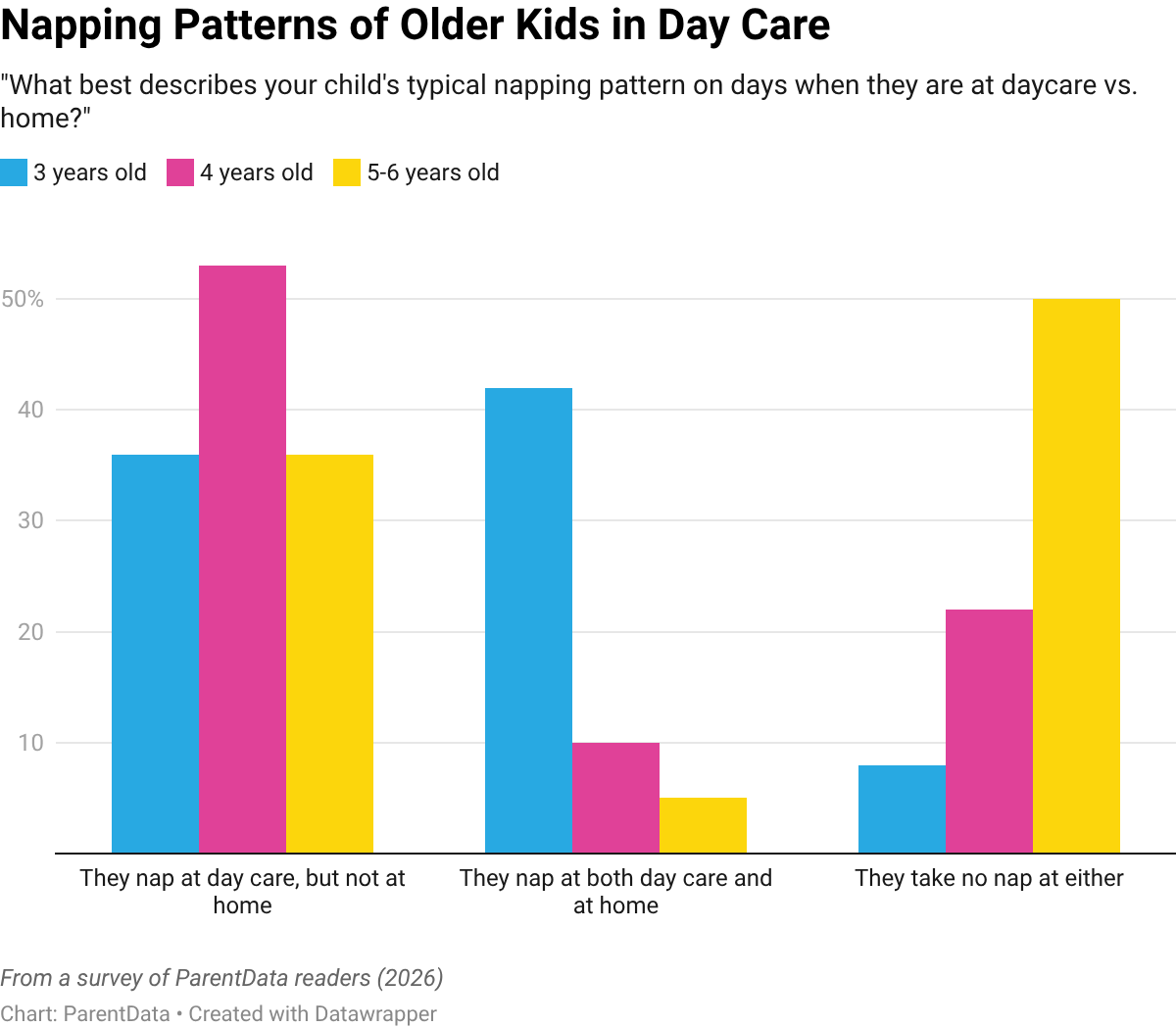
The issue here is most acute for 4-year-olds. In this age group, more than half of parents say their children still nap at day care, but not at home. For 3-year-olds, the “nap at both” pattern is more common, and by age 5, the “nap at neither” pattern dominates.
Parents of 4-year-olds are the most likely to report being unhappy with this situation — 40% of them wish their child slept less at school. And a full 75% of that group says the consequence of more sleep at day care is a later bedtime at home.
These numbers tell me it’s not every parent in this boat, but for people who are, this is really affecting them. That shows up not only in the data, but also in their stories:
“It’s a terrible cycle. He naps, stays up super late, is exhausted the next morning, and sleeps hard at nap. He never naps on weekends anymore. It is really affecting my wife and I. We are exhausted trying to get him to settle after 10 pm.”
“It’s incredibly frustrating and severely impacts home life when 5 days a week she is forced to take a nap that pushes her bedtime from 7:30 pm to 9:30/10 pm. Particularly hard on us now that we have a newborn.”
I heard from parents both a concern about whether this is best for their kids and, also, a real tension with what works for family life. For many families, the time after the kids’ bedtime is a chance for adult connection and some regrouping at the end of a busy day. When that is taken away, family mood and function suffer.
What does the research say?
We can start with the big picture of how sleep evolves over time. Newborns sleep very unpredictably, as we all know. As kids age, sleep becomes more regular and predictable — first coming together into three naps and a nighttime period, then two naps, then one nap, and finally dropping the nap altogether. Data shows that most kids drop their final nap around 3 or 4 years.
An important point is that total sleep doesn’t drop that much as kids age; the decline in nap time tends to be made up in more bedtime sleep.
When we turn to the data on day care napping in particular, there are two questions to ask of the research. First, does the data support our parents’ general impression that daytime naps interfere with nighttime sleep? And, second, is this a problem for kids?
The answer to the first question about nighttime sleep disruption is yes. In one study of children ages 3 to 5 years in child care centers, researchers collected detailed data (from wearable trackers) on sleep. They found that children who napped during the day slept less at night. A similar paper (great title: “Daytime nap controls toddler’s nighttime sleep”) shows the same result and notes that naps later in the day can impact nighttime sleep even for younger children. In both cases, the shortening of nighttime sleep seems to stem from kids falling asleep later if they have napped. Summary work notes a clear link between naps and less nighttime sleep. This isn’t up for debate.
The answer to the second question about how that impacts development is less obvious. It’s well understood that naps are necessary for childhood development up to a certain point — basically, young children need more sleep than they can get at once. However, for older kids in preschool and beyond, the cognitive benefits of naps are not as clear. Some papers find that daytime napping is negatively correlated with performance on cognitive tasks for preschoolers. The authors suggest this may be due to the daytime naps interfering with nighttime sleep, which is more important for neurodevelopment. On the other hand, other studies have found that morning learning activities are reinforced by napping (kids are more likely to remember them), at least among habitual nappers. The evidence here isn’t ironclad either way, and all the effects are fairly small.
Another way to put this together: If your ideal family schedule is a child who is up late with you and naps during the day, that’s probably fine for the cognitive development of a 4-year-old. The main problem here is that for many families, that isn’t their best schedule. And the data is clear that the daytime nap is making bedtime worse without clear developmental benefits.
Why is this happening?
In principle, it seems like this problem has a simple solution: don’t have all children nap. What many parents would like is for their children to have the same structure at day care that they have on the weekend. If children want to nap, great. But for those who typically don’t nap at home, maybe there is the option for some quieter playtime in the afternoon instead.
Getting to this solution, however, often seems difficult. Many parents in our survey reported they felt powerless to change the child care center’s nap policy. They also often report being told that this is the law — that day cares are required to provide nap time.
There is some truth to this, but also a fair amount of more nuance. Policies about child care center napping vary by state. Many (not all, but many) states do have a requirement that children under 5 years are given an opportunity to nap if they are in full-time care. However, many of these policies also indicate that if children do not fall asleep or do not need a nap, they should be allowed to do quiet activities after some period of time.
For reference: if you are interested in the policy for your state, we’ve put together a document with these details.
Unsurprisingly, given the level of frustration, many parents told me they have looked up these policies, and they are struggling to get their child care center to allow their child to play quietly rather than napping, even when that’s part of the law. One parent told us:
“We actually asked the teacher if she could be allowed to play quietly instead and were told that the nap was required because of state law.”
But when I looked into their particular state law, it explicitly says that quiet play should be allowed and naps should not be forced.
In practice, some of what is going on here is much more practical. Nap time is an opportunity for caregivers to have a (much needed) break. In some cases, state law explicitly allows a lower caregiver-to-child ratio during naps, which means teachers can be out of the classroom for a period of time. But even when that isn’t true, nap time is quieter.
If we acknowledge that breaks are needed, there is a trade-off here: child care centers could hire more staff, allowing them to have breaks even if children aren’t napping, but then they would have to charge parents more. As I’ve talked about before, child care is expensive, and most of the costs are staff time. Adding another teacher would make things more expensive for everyone.
There’s no secret option C here — just trade-offs. At least one parent in our survey reported that they have an option to pay more for their child to do non-napping activities outside the classroom during nap time; this at least directly acknowledges the choices that schools are facing.
Are there any solutions?
If your family is struggling with this, it’s absolutely worth a conversation with your child care provider about what is possible. In some cases, a note from your child’s doctor (seriously) may be helpful.
My hope in describing the limitations above is to give you both the policy information and the context for having a productive discussion here. Getting together with other parents may also help prompt solutions.
And I will also say: this does end, although it may not seem like it. Even in this survey, the parents of 5-year-olds are generally happier because most of those kids aren’t forced to nap and, even when given the opportunity, generally will not. It’s worth trying to fix this, but also just hang in there.
The bottom line
- Daytime naps at day care generally push back bedtime for older kids — this is well supported by the evidence.
- The cognitive case for napping at ages 3 to 5 is weak. Total sleep matters; where it falls in the day matters less. If the nap is costing you nighttime sleep and isn’t working for your family, that’s a problem worth addressing.
- State laws often require quiet rest time, not mandatory napping, and many allow quiet play for kids who don’t fall asleep. It’s worth looking up your state’s policy and having a direct conversation with your provider.








Log in