






There are many nice things about summer. More time with my kids! Camp! Travel!
One of the less nice things is the rashes. Between sunscreen and bug spray and heat and the fact that everyone seems inexplicably drawn to touching weird plants, it’s usually the case that at least one of us is fighting off some undefined skin-related problem.
The situation is, however, much better than it was a few years ago, when we were fighting an identified problem with one of my kids: eczema. This was also exacerbated by the summer, and it got bad enough that we ended up at a specialist dermatologist, trying to figure out what to do.
We are not alone. Eczema is common in kids — estimates suggest 10% prevalence in the U.S. — and it also occurs, though less commonly, in adults. Today’s post is an eczema explainer. What is it, and what are the symptoms? What are the treatments, both baseline and advanced? Is there any method for prevention? And, finally, is there a link with other allergies?
My hope is that this will be useful if you’re dealing with it now. And, if not, save this in case.
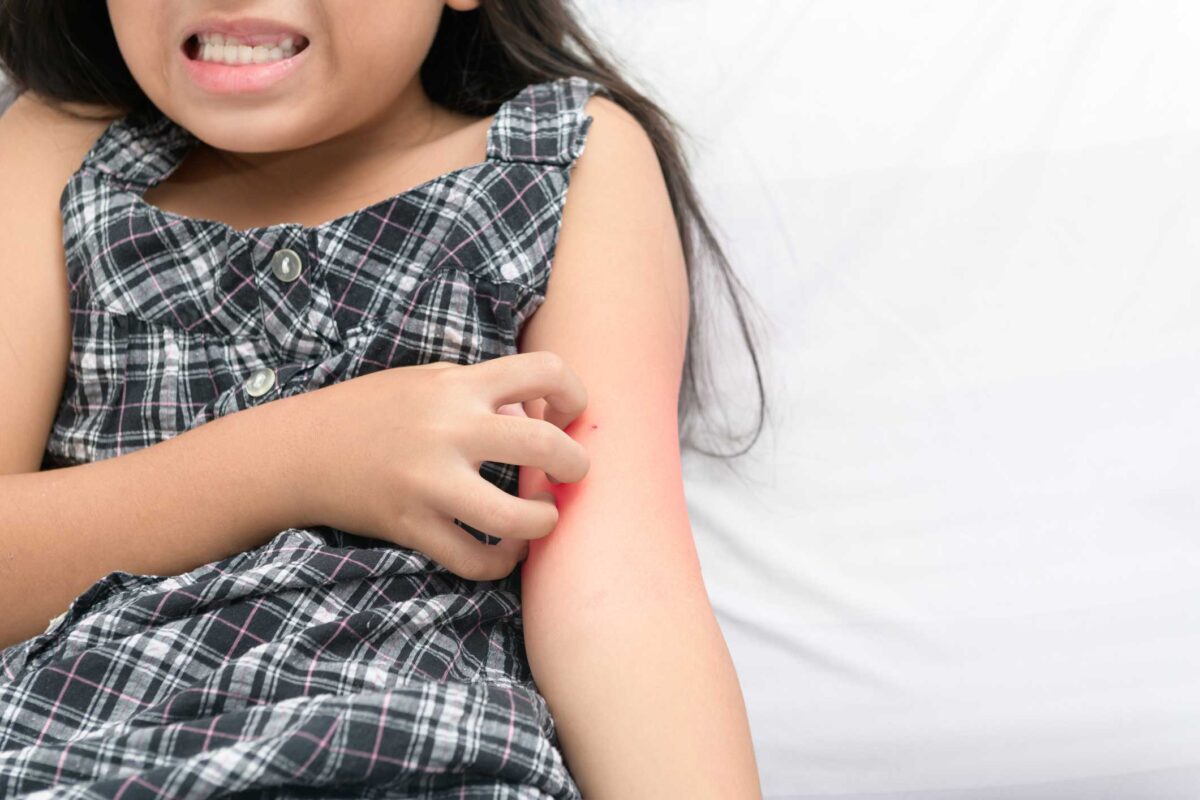
What is eczema?
The technical name for eczema is “atopic dermatitis”; I’ll use “eczema” here since that’s what most people are familiar with. It’s a chronic inflammatory skin disease. The key symptoms are dry skin and itching, sometimes severe. Within this, eczema can present in a variety of ways: scaly dry skin, something that looks closer to crusty sores, red skin (in lighter-skinned people), or very dark patches (in darker-skinned people).
Eczema can appear anywhere on the body. In infants and young children, it’s most common on the cheeks or scalp. In older children, other body parts (neck, wrists) are often involved. The only body locations in which it is not common are the butt and groin area.
It’s important to say that while eczema is highly varied across people in presentation — symptoms, experiences, body locations — dry skin and itching are the key shared features.
Severity varies considerably and is defined largely based on how disruptive the illness is to everyday functioning. Limited itching and little impact on everyday activity or sleep: mild. More moderate impact on activities and sleep: moderate. Severe impact on activities and sleep: severe.
Itching is really the most problematic part here. It’s hard to sleep and do normal activities if everything itches all the time.
Eczema, like many inflammatory diseases, is characterized by flares. It will get worse, then better for a time, then worse again.
How do you treat eczema?
There are many possible treatments for eczema. In fact, there are so many approaches that it can seem a little overwhelming — some things are useful for treating symptoms, some for treating the underlying issue. There is a vague order, but it varies from person to person. In the end, some of it is trial and error to figure out what works in any particular situation.
The list below tries to summarize in a useful way the gradual escalation from general, first-line good practice to more significant treatment options.
Use a lotion to moisturize regularly
The number-one first-line defense for eczema is lotion. This would ideally be used at least twice a day, one of which is after a daily bath. So you take a warm (not too hot) bath, then apply a lotion or ointment to the affected areas. This activity is called “soak and seal,” which I kind of love.
What should you apply after the bath? Generally, the recommendation is to use something like Aquaphor or Vaseline, which are very thick and have no water content. However, it’s not clear that this recommendation is supported by data; the evidence basically suggests that any lotion is fine. The most important thing is to find an approach that you can consistently implement.
Overall, Randomized trial evidence shows that using moisturizer has a strong positive impact on eczema. For children who are prone to eczema, using lotion religiously can be helpful even if they are not currently having a flare.
Avoid exacerbating factors
There are some things — bathing too frequently without moisturizing afterward, spending time in low-humidity environments, using scented detergents — that should be cut out if possible. Unlike lotion, this isn’t very specific, and avoiding some of these exacerbating factors may be impossible; if you live in a low-humidity environment … you just do. It’s worth considering in case something seems actionable, like switching the detergent you use for your laundry.
Use a topical treatment to relieve itching
As noted, the most disruptive aspect of eczema is the itching. With kids in particular, itching is both a problem in itself and can exacerbate other issues. Skin is dry, it itches, then kids scratch and the skin breaks, and now you’ve got sores along with the itching. The lotion approach described above can be helpful, though it is often not enough during a flare.
The most widely used anti-itch treatment is topical corticosteroids, which have been shown in randomized trials to reduce itching. This is likely to be the first approach to itch control recommended by a dermatologist if the itching is disruptive. A second topical treatment — calcineurin inhibitors — is sometimes used in areas, like the face, where steroids may have more complications. There are a couple of other approved topical treatments that may be considered if these do not work. These treatments are all commonly used during flares and often discontinued afterward, since there are concerns about long-term use, and these are effective largely as treatment rather than prevention.
One thing to note is that a main reason for treatment failure is thought to be a lack of adherence to treatment. People under-use prescribed steroids, perhaps for fear of side effects. It can also be difficult to follow through on the elaborate bath-lotion situation, given that, you know, children are children. This is a case where making a concrete plan you think you can stick with, and talking about your constraints with your doctor, is really central.
Systemic therapy: dupilumab
For most kids, a combination of the above approaches will be enough. However, if they are not, and if eczema continues to disrupt their life, it may be necessary to engage in more serious treatment. The top-line treatment is a monoclonal antibody called dupilumab, which has been shown to be very effective at reducing eczema symptoms and is approved for people over six months. The efficacy data on this are mostly on adults and older children, but approval based on safety goes down to infants.
There are other drugs in this general space, but they are not used for young children. Adolescents and adults with severe eczema have more treatment options.
Can you prevent eczema?
Prevention in this setting has two angles.
First, for children who have had outbreaks of eczema in the past, we could ask how future outbreaks might be prevented. Ongoing regular use of lotion, combined with being careful about exposure to perfumes and other itch-producing products, is the standard (and effective) approach.
A second question is whether there are actions you can take early on that would prevent its development at all. The most widely attempted intervention is early treatment with lotion. That is: try to stave off the development of eczema by starting a lotion regimen immediately. There might be some logic to this, but randomized trial evidence doesn’t support it as a general policy. A 2021 meta-analysis of these trials showed that early-life lotion use didn’t prevent eczema development. This doesn’t mean you shouldn’t use lotion on your baby for general skin health, but the evidence isn’t strong for this impact.
Beyond lotion, there is some mixed but ultimately unconvincing evidence on probiotics.
Overall, vigilance and intervening early if your child does develop eczema may be the only really successful prevention.
Are kids with eczema more susceptible to other allergies?
Kids with eczema are more likely to develop seasonal allergies and asthma later in life, and they’re also more likely to have food allergies. This is sometimes called the “atopic march,” which I think is an unfortunate name, but there it is. This relationship is clear in the data.
The link may be due to similar underlying characteristics causing multiple conditions. It has also been speculated that having eczema may have a causal impact on the development of later allergies, since the introduction of allergens through the skin irritation could generate sensitivity. This mechanism is still debated, and trials are underway to evaluate it more completely.
Regardless of the reason, it’s good to be aware of this link. Importantly, though, this does not mean you should avoid allergenic foods like peanuts or eggs. In fact, early introduction of these products (which has been shown to reduce food allergies in general) may be more important for children who are in these higher-risk groups.
Closing thoughts
Eczema is common and, for most kids, once you figure out how to treat it, quite manageable. For severe cases, there are more advanced treatments, so you and your kid shouldn’t have to suffer.
In my own family, we figured out a magical cocktail of maximum-strength Eucerin and Aquaphor, which we buy in disturbingly large tubs. Yes, the sheets are covered with oil stains. But no one’s itching, which I see as a win.
The bottom line
- Eczema is common, chronic, and characterized by flares. The mainstays of treatment are regular moisturizing and topical steroids during flares.
- For most kids, consistent lotion use plus topical treatments is enough. For severe cases that disrupt sleep and daily life, dupilumab is highly effective and approved starting at six months old.
- Kids with eczema are more likely to develop asthma, seasonal allergies, and food allergies. That’s worth knowing, but it’s not a reason to avoid allergenic foods — early introduction is still the right call.








Log in
I’ve been reading that monoclonal antibody treatments can prevent subsequent asthma and food allergy development in toddlers with eczema. Emily, I wondered if you could write an article about that?
I’ve had eczema pretty badly my whole life (it comes in waves – some days/weeks/months/years are worse and some are clear) but as an adult the one thing that has single-handedly cleared up my eczema is acupuncture!! Highly recommend for any other adults with eczema they can’t get rid of!!
My kiddos all have eczema, like me. The best advice the pediatrician gave me was that whatever works for me should work for them. We found Aquafor made scaly skin worse for even bleed because of a lanolin sensitivity shared by all of us. It must not be terribly common since I found out I was sensitive after using a lanolin forward nipple cream.
Is there any evidence on elimination diets for eczema?
I guess it could be in the “Avoid exacerbating factors” category, but it makes more sense in the “my child always has flares after strawberries” case and less in the ” I eliminated ALL allergens from his diet and after the eczema is gone, we will try exposition to them one after one” case. Any thoughts?
would love to know this as well! often hear about cutting dairy for breastfeeding moms
Is it possible my baby would have one flare up of skin irritation and never have eczema? We are currently on cows milk formula and switching to goats milk. Praying this is just a minor allergy that can be solved and will not be an issue.