






My partner and I have the opposite problem to the one you are often talking about fussy eaters. Our daughter eats basically everything and always wants more, so how do we know what portion size is reasonable? Since she started with solid foods at six months old, she has eaten almost everything we’ve put in front of her. Now that she’s learned to ask for more, she does that all the time, even after second and third helpings.
We’ve read that babies know their limits, so we’re not sure if and when we should be worried about her overeating. Our health visitor (a kind of local community nurse, a public service here in the U.K.) gave us a guide with portion sizes that are ludicrously small (e.g. 2-3 berries or grapes as a snack for a child aged up to 2 years): our daughter eats multiples of the amount they suggest. Very grateful for any advice or guidance on this.
—Rob
Kids, like adults, vary a lot in how much they eat. This is true both across people and over time within a person. Once, my 1-year-old ate an entire pint of blackberries in 15 minutes (do not recommend — terrible poop consequences). On other occasions, she would eat more or less nothing all day.
Kids are actually much, much better than adults at figuring out whether they are hungry. As adults, we typically eat on a fixed schedule, a fixed amount, and, often, unfortunately, either over- or undereat trying to achieve some particular goals. Kids are more natural intuitive eaters. Which is good! What many of us would like to do is raise kids with expansive tastes, who eat when they are hungry and not when they are full. That’s the idea behind “intuitive eating.”
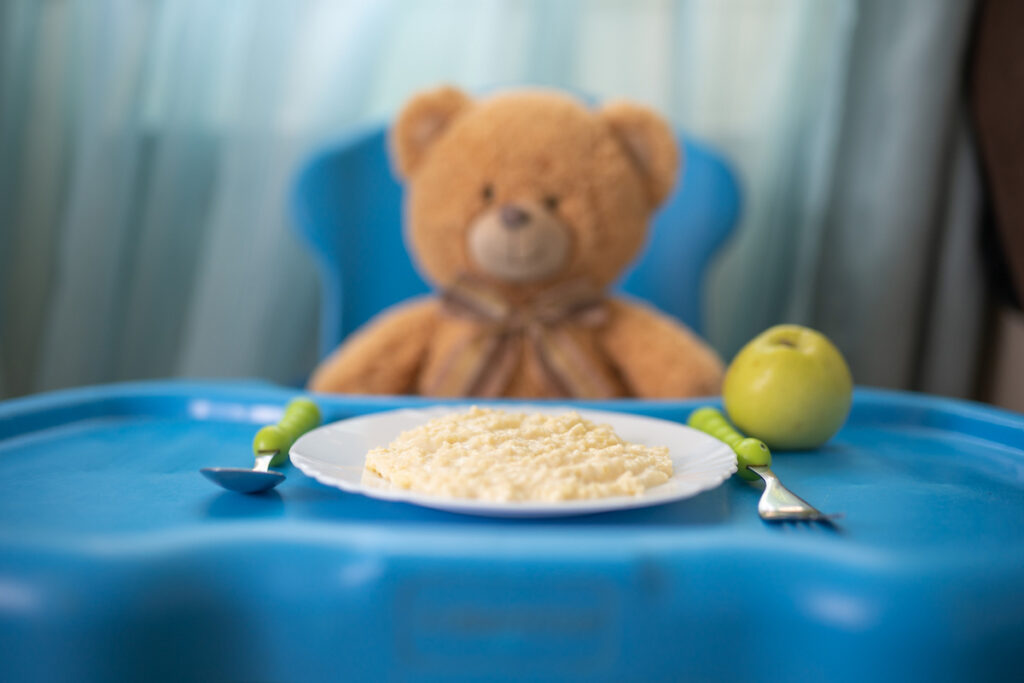
This is not the same as saying that there should be no restrictions or guidance coming from you. Most kids have a pretty strong sweet tooth, and you would not want your child eating unlimited candy (or unlimited blackberries, or unlimited anything). The opportunity for you is to provide a balanced set of foods.
This is well-encapsulated in the advice You decide what they eat; they decide how much. You offer a set of foods — ideally a balanced diet with protein, some carbs, vegetables, fruits, fat, some treats, etc. — and they choose how much. You might choose to put some restriction on this — say, no seconds on dessert — but overall, giving your child the control to have more chicken … this is a good idea.
Also, three grapes is not a sufficient snack for anyone. That has about 6 calories. Your child needs about 1,300 calories a day. So while fruit is a good part of a snack, three grapes is ridiculous.
(Final note: There are some genetic conditions in which people lack fullness hormones and will overeat to the point of illness. If you have this concern, it would be a good idea to discuss with your doctor. But it doesn’t sound like that’s the case.)
Community Guidelines





Log in
I have to say, I think this is pretty bad advice. My husband and I have been struggling with the same issues with our toddler (23 months) for a year and a half, just like the author. It can be really challenging — and it is extremely hard to find research-backed advice because, as the author wrote, it seems that all parents struggle with the exact opposite problem. The idea that we should just let him eat however much he wants of certain foods has not worked. Our son would eagerly eat 8 oz of salmon or probably a pound of cheddar cheese if we let him. He is intensely distracted by any food that he sees someone else eating. What has worked is eating meals as a family, starting and finishing at the same time; trying to draw out meals to also include talking with and playing with food — this gives him time to start to realize that he’s getting full; and giving him high-fat high-protein snacks that prioritize vegetables over fruit. We let him have seconds, but often not thirds. His appetite seems to be slowing very incrementally.