






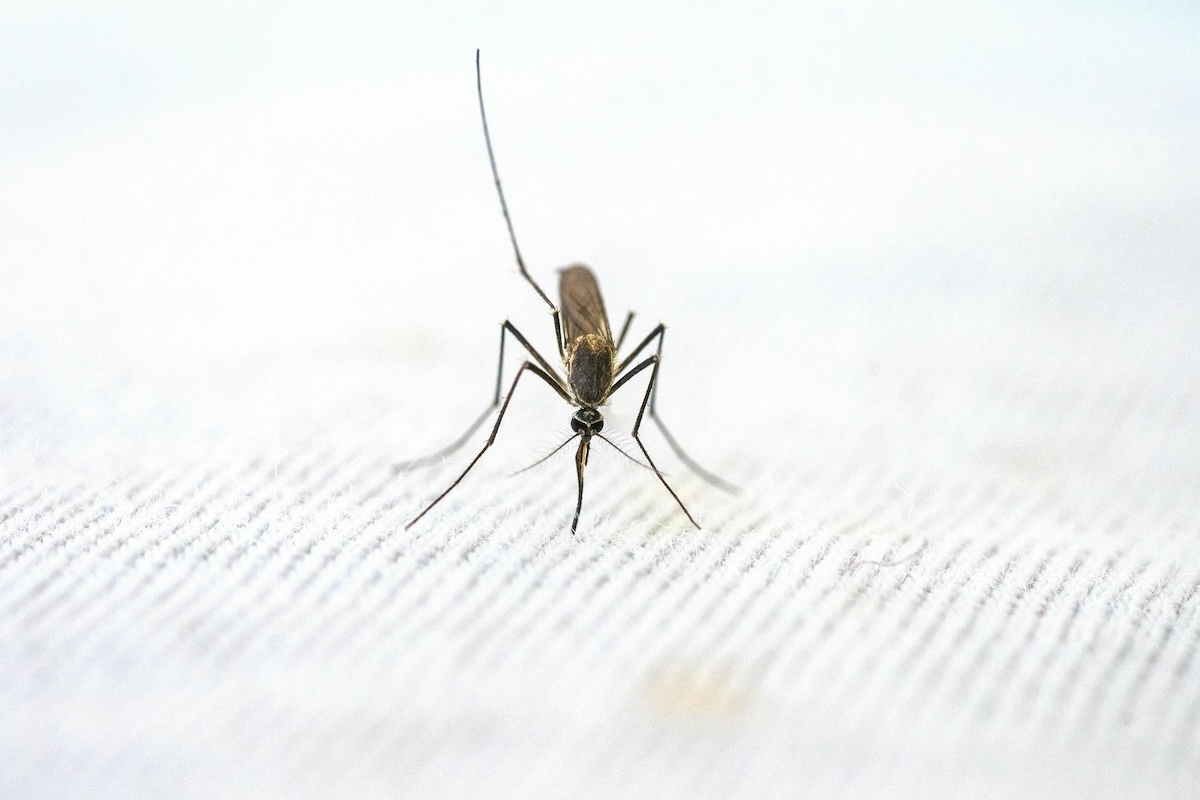
Globally, mosquitoes are the deadliest animal by a wide margin. They kill an estimated 700,000 to 1 million people every year through their role in spreading disease. This is twice as many as the next-deadliest animal (humans) and 20 times as many as snakes. Most of these deaths are in the developing world, and the vast majority of them are a result of malaria.
In the U.S., malaria is not consistently present, but mosquitoes can carry other diseases, some of which can be dangerous. An increasingly common occurrence, at least in the Northeast, is summer restrictions on evening activities because of the presence of Eastern equine encephalitis (EEE), which is very rare but has a 30% mortality rate.
Beyond disease, mosquitoes are an enormous nuisance, and some people have an extremely bad reaction to their bites.
At the same time, my childhood was full of mosquito bites (usually accompanied by a terrible sunburn). It’s tempting to look at all of the discussion and wonder — is this just another overly cautious parent panic headline? Should we really just have more of a 1980s-chill-out vibe about mosquitoes?
Let’s dive into these questions, plus perhaps the most important one: Why do mosquitoes like some people much more than others?
Which diseases can you get from mosquitoes?
Mosquitoes can spread a variety of diseases. This happens because mosquitoes are a vector, flitting from animal to animal, including humans. When a mosquito bites one person who has, say, the virus that causes yellow fever, it ingests the virus. The virus makes its way to the mosquito’s salivary glands. When the mosquito bites again, it transfers its saliva in the course of the bite (this helps it feed), and the virus gets into the new host.
In this way, mosquitoes can transfer viruses, bacteria, or parasites. Malaria is caused by a parasite, but other common mosquito-borne diseases are viruses (yellow fever, Zika, West Nile) or bacteria (for example, tularemia).
Hundreds of years ago, various parts of the U.S. had endemic malaria, yellow fever, and other mosquito-borne illnesses. That is no longer true, but there are a number of illnesses that mosquitoes in the U.S. do cause. These are summarized below.
All of these are notifiable diseases, which means the CDC is told about any detected cases of the virus. In many cases, people who are infected have no symptoms or very mild symptoms, which are probably not reported. The numbers below are counts of more serious illnesses.
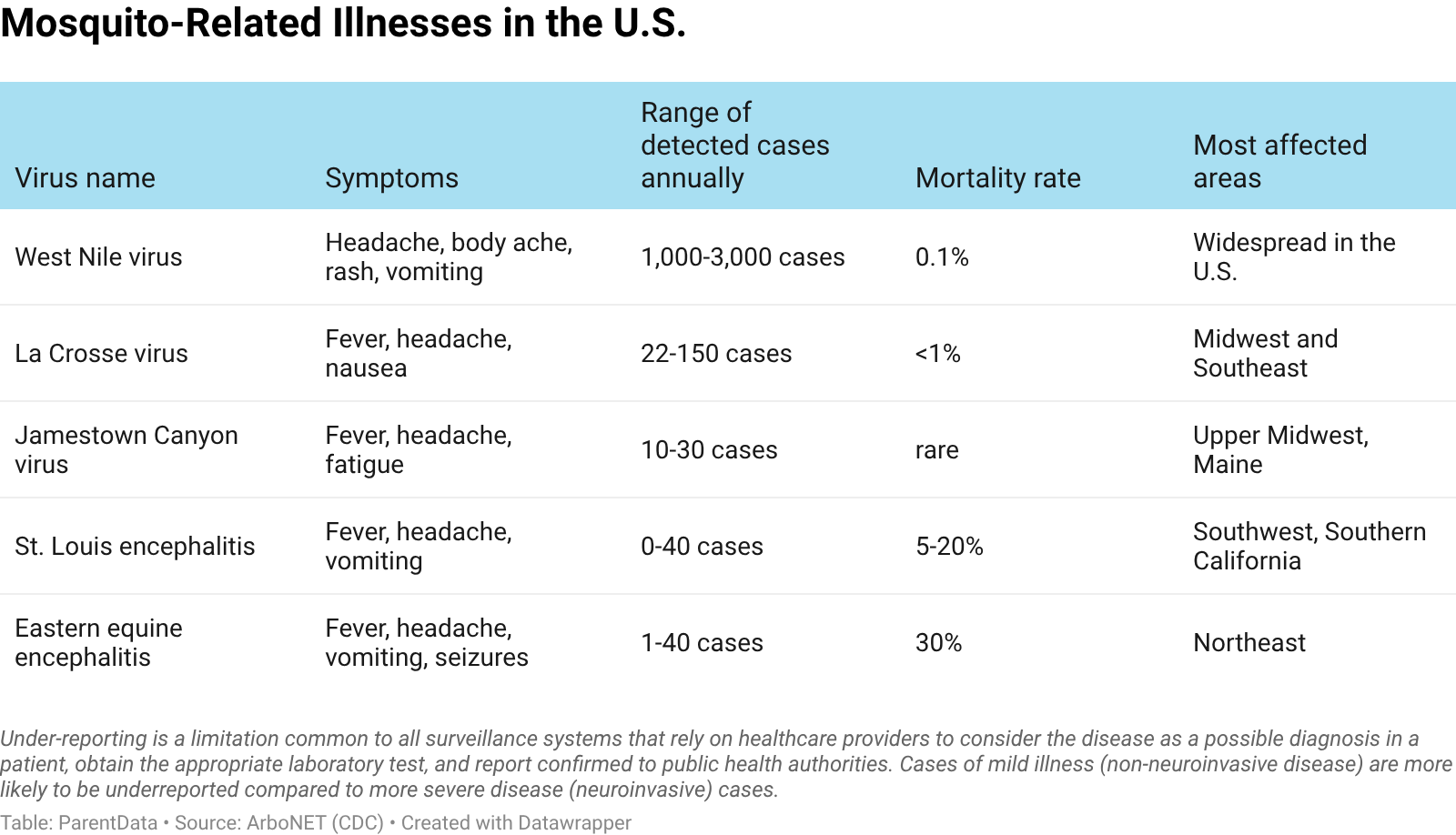
(You can see details and counts for all of these at the CDC’s ArboNET.
Not included in this list are things like dengue and Zika, which are not endemic to the U.S., but you may encounter them when traveling to other countries.
Of these illnesses, West Nile is — in my view — the only one common enough to think seriously about prevention. Others like EEE are terrifying. But the reality is that this summer, you are much, much more likely to be injured in your car than to contract this virus (even if you take no precautions).
Not every mosquito species spreads disease; most mosquito species do not. This isn’t very helpful in the moment, since you probably cannot identify different species, but it does come up in the question (below) of whether we could get rid of mosquitoes completely.
From a serious disease standpoint — at least in the U.S. — are mosquitoes a panic headline or a real threat? I would give them a caution-but-not-panic rating. Serious diseases from mosquitoes do happen, but they are really quite rare. The main reason to avoid mosquitoes is that their bites are very unpleasant. Not getting serious diseases is a side benefit.
How should I treat mosquito bites?
Mosquito bites are awful. When I was a kid, they told us not to scratch them, which I repeat fruitlessly to my own children. What kind of advice is that? Someone once told me that if you press an “X” across the top of a bite really hard with your fingernails, it will stop itching. That doesn’t really work!
The bites itch because your immune system reacts to the mosquito saliva, (correctly) viewing the saliva as a threat and mounting a response. This response includes a histamine, which is what causes inflammation and itching. When you itch, this prompts more histamine. Which is why, yes, scratching your bites can make the itching worse.
For most people, there is nothing inherently dangerous about itchy mosquito bites (beyond the disease risk above), although if you break the skin with scratching, they can become infected. But the worries here are largely about comfort.
There are many anti-itch creams on the market. Hydrocortisone 1% can help reduce inflammation and therefore relieve itching. Another oldie but goodie is Caladryl (calamine lotion). It’s not a steroid but a mix of zinc oxide and ferric oxide, and it’s great for itch relief.
Some people — kids and adults — have much larger reactions to mosquito bites. This can come in the form of an allergic reaction that develops a few hours later and causes wider swelling of the area. This is sometimes called “skeeter syndrome,” which is a ridiculous name but hard to forget. If you or your child has this, the types of treatment options (steroids, antihistamines) are similar to those for a smaller bite, but you may need more of them. This is a time to call your doctor.
How can I prevent mosquito bites?
The best way to avoid all the problems that come with mosquitoes is not to get bitten. But how?
First: Wear long sleeves. This is probably not generally practical, but if you’re hiking in a mosquito-infested area, wearing long sleeves may be necessary protection.
Second: Apply insect repellent when you go out. Two options are well-supported here: DEET and picaridin. Both are recommended by the AAP and can be used during pregnancy and on kids over 2 months.
I hear you saying isn’t that dangerous? For DEET: Yes, it is technically a poison, and you certainly do not want to ingest it. However, when used correctly, it’s fine.
Here’s a review article, entitled “Is DEET a dangerous neurotoxicant?,” to which the answer (by their reporting) is “no.” The AAP recommends no more than 30% DEET; at this amount, you get about 5 hours of protection. Picardin is an alternative — it can offer 8-12 hours of protection at 20% concentration.
Third: Spray permethrin on your clothes and shoes. Permethrin is a spray that mimics a chemical in chrysanthemum flowers. It’s not something you use on your body, but instead you treat your clothes and shoes with it, and it kills mosquitoes (or ticks) when they land on you. You could also treat socks, jackets, and (if you like camping) your tent. It lasts for six months.
Finally: If you’re going to be hanging out in one place outside, you should absolutely get one of these (this isn’t a paid ad! I just love this!). It’s a small device that you set up outside in the area where you’ll be sitting, and it repels mosquitoes in about a 20-foot radius. It’s like an actually effective, odorless citronella candle. There is experimental evidence that this type of product works, and I will say, from personal experience, it has totally changed the outdoor possibilities in my household.
Reality check: Nothing will prevent you from getting a few mosquito bites, and I do not want you to panic about them! But if you do these things, you’ll get fewer.
Why do mosquitoes love me in particular?
Because you’re special and wonderful! Actually, we do not really know.
Mosquitoes seem to be drawn more to some people than others. One reason is that some people exhale more carbon dioxide, effectively making themselves easier to find. Mosquitoes also seem to like people who have a higher body temperature.
The strongest evidence relates to carboxylic acid levels in your skin. Some people have tastier skin chemicals! Sadly, there’s not much you can do about this. I do recommend finding a spouse who has a more attractive set of skin chemicals so they can siphon off the bites.
Can we get rid of all the mosquitoes?
It is tempting to consider eliminating mosquitoes, but this is a complicated proposition. Other animals (birds, amphibians, etc.) eat mosquitoes, which means completely removing them would have downstream effects that are quite hard to anticipate. There isn’t much scientific support for total elimination.
There is more support and experimentation underway to try to eliminate the species of mosquitoes that spread most diseases. The approach is generally to introduce gene-modified mosquitoes (typically, sterile males) who can out-compete the local male mosquitoes and cause populations to collapse. An experiment in the Florida Keys showed some support for this approach, and a recent paper in Nature had promising results from Tanzania, in efforts to reduce malaria-carrying mosquitoes there.
It seems very possible that we’ll see a reduction in disease-causing mosquitoes in the next decade or so, although this will be (appropriately) focused on those that cause serious disease. So you’ll still need to watch out for bites.
The bottom line
- Mosquitoes can spread disease, although mosquito-borne disease is still rare in the U.S. West Nile is the most common.
- Itching can be treated with a steroid cream or calamine lotion. For more serious reactions, consult with a doctor.
- Prevention options include long-sleeved clothes, DEET- or picardin-based repellent on your body, permethrin sprayed on your clothes, and area-level protection.
- Mosquitos prefer some people more than others. We don’t know exactly why, sorry!








Log in
My kids go to several day and sleepaway camps each summer. We take a day at the beginning of camp season to spray-treat 8 outfits for each of them with permethrin, including hats, socks, and shoes. We take photos of those outfits and then that’s what they wear to every outdoor camp. Because at-home permethrin treatment is effective through six weeks or six washes, this is an added layer of protection, especially for the sleepaway camps when I’m not there to supervise their daily picaridin application.
I’m disappointed to see that after being updated, this article still doesn’t mention picaridin, which the AAP recommends equally with DEET. Depending on concentration, picaridin is effective for longer. It also doesn’t chew through plastic.
We’ve updated it to include picardin. Thanks for the feedback!
Such a helpful article. I would love to read a deeper dive on DEET-based repellants in real-life situations. It’s safe if it isn’t ingested and used correctly. But what does that mean in relation to kids who might touch their treated legs and then put their hands in their mouths?
My father died from complications of West Nile Virus, contracted in a NJ backyard. A horrible disease, worth far more than an ounce of prevention – hoping we’ll have a vaccine one day for people (right now, it’s only for horses).
My infant keeps getting mosquito bites on his forehead – not a place adults usually get bit, and not somewhere I’m eager to put DEET even if generally safe! Any additional head-specific ideas for prevention?
Hat?
What are your current thoughts on the risk of Dengue in the Caribbean? We have a March trip planned for St. Barths (2nd trimester) and am wondering if I should reconsider? Would appreciate any help sorting through the information!
Have you used Picaridin? It’s also made by Sawyer and claims to be safer than DEET? We’re traveling to Massachusetts next week and trying to find the safest and most effective option for my 20 month old.
I live in MA and swear by the sawyer picaridin repellent! Mosquitoes love me and I never get bites with it. No issues using it on my 1 year old either!
What about those repellent patches that you attach to clothes? Do they work?
They work really well for me and my kids. I have the allergic reaction to the bites and the patches have made a huge difference. I use Quitch, although there are multiple out there. My son who has the same reaction as I do will stop itching and scratching when I put them on. I wish I had them as a kid!